Saturday, October 05, 2013

OCTOBER READING GROUP UPDATE


The New Book Club: 


Tina's Group:


World's Smallest Reading Group:


Once Upon A Time Bookstore Adult Fiction Group:


One Book At A Time:


Bookie Babes:


What are your groups reading this month?

Friday, October 04, 2013

THE CARPETBAGGERS


The Carpetbaggers, Harold Robbins, Simon & Schuster Inc, 1961, 679 pp


Harold Robbins wrote many bestsellers over his long career and this one was the #4 bestseller in 1961. It was also made into a movie. Robbins hits all the tropes of a big fat trashy page turner. I read tons of books like this when I was in my thirties, raising my sons and dreaming of adventure. It was kind of fun to read one again now that I am such a literary fiction reader.

Jonas Cord, a motherless kid with a Native American cowboy named Nevada Smith as his male nanny, was raised in the Nevada desert on his father's ranch. Mr Cord Sr was a fabulously wealthy, hard bitten tycoon whose tough love left Jonas feeling unloved. When his father keels over from a stroke, Jonas inherits the business at age 20. 

He does his best to become his father, even trying to marry his father's wife. Within a few weeks he suddenly develops business savvy, though he loses out with the wife. He is already a pilot, a womanizer, a hard drinking fearless dude. On it goes through WWI, WWII, the rise of Hollywood, airplanes, and modern life as it was known in the late 1950s.

The women are all beautiful and sexy, the men ruthless and violent, and everyone has something in the past making them act the way they do. Very entertaining, especially the Hollywood parts. I suppose most men wanted to be tycoons and most women wanted to be movie stars in 1961; heck, many still do!

How satisfying to read that the rich and famous also have hard times. Reading it today with all its sex and glamor and business high jinks, I saw that business ethics and Hollywood's methods have always been on the shady side, that human nature craves such stories, and that women are only a couple generations beyond the objectification and exploitation that was simply taken for granted in 1961.

But I never did figure out why the book was called The Carpetbaggers.


(The Carpetbaggers is available in mass market paperback by order [and subject to availability] from Once Upon A Time Bookstore.)

Thursday, September 26, 2013

GOING ON VACATION


ROAD TRIP!!


I am going on vacation. I usually do this time of year after the tourists have gone back to work and school. I am driving up the I5 freeway to visit a friend. I have two books on my iPad: Duplex by Kathryn Davis and Thinner Than Skin by Uzma Aslam Khan. In case technology fails, I have two print books: Cartwheel by Jennifer DuBois and The Night Circus by Erin Morgenstern. 

But really I plan to relax, hang out with my friend, eat her astounding cooking, maybe take a walk in the woods. I will be back next week with more reviews, perhaps a little travelogue. 


Tuesday, September 24, 2013

THE CUCKOO'S CALLING


The Cuckoo's Calling, J K Rowling/Robert Galbraith, Mulholland Books/Little Brown and Company, 2013, 448 pp


J K Rowling can sure write a good story. She proved that seven times over with the Harry Potter series. Some say she didn't do as well with her first novel for adults, The Casual Vacancy. I haven't read that yet so I can't say. Writing under the pseudonym Robert Galbraith, she demonstrates her chops in The Cuckoo's Calling.

Call it a mystery, a thriller, or a work of crime fiction (it is all of those), she entertained me on every page. Private detective Cormoran Strike and his "temporary" office girl Robin are complex characters whom I grew quite fond of. It is a feat that supermodel Lula Landry comes across as a fully realized character even though she is dead throughout the entire book.

Then there is Rowling's knowing take on pop culture, fame, paparazzi, social networking fans, and too much money. I know that sounds like a lot of stuff but she weaves it in seamlessly.

Finally, I really don't like it when I can figure out who done it before a mystery ends. I had no idea until it was revealed.

That is all I am going to say because any more would spoil the reading experience one way or another. I hope she does a series. I want more of Strike and Robin.


(The Cuckoo's Calling is available on the shelves in hardcover and in eBook by order from Once Upon A Time Bookstore.)

Sunday, September 22, 2013

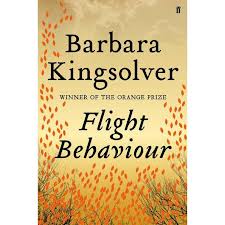
FLIGHT BEHAVIOR


Flight Behavior, Barbara Kingsolver, HarperCollins, 2012, 386 pp


Wow! Back to back, I read two of my favorite authors. Immediately after finishing Margaret Atwood's MaddAddam, I began Flight Behavior. It was equally great.

Barbara Kingsolver, aside from being a wonderful storyteller, always brings a societal issue to life with stories about characters living under the influence of said societal issue. In Flight Behavior, Dellarobia Turnbow is a frustrated wife and mother, living in near poverty in a small Appalachian town. The story opens on a day when Dellarobia has decided to be unfaithful to her husband. On the way to a prearranged tryst, she witnesses a forest valley filled with an orange flaming light.

Religion is a big deal in Feathertown, TN and though she is not a true believer, Dellarobia goes to church just because one must. But she is so stunned by the vision in the valley that she feels a miracle has saved her from making a big mistake.

Before long it becomes clear that the valley, which is on her in-laws' property, is filled with butterflies that have detoured from their normal migratory route. Soon enough, the scientist Dr Ovid Byron, the media, the townspeople, and the in-laws are embroiled.

So the story is about climate change, about religious fundamentalism, about the inability of all of us to believe that we have already just about killed off our planet. But it is also about a woman, who through her own foolishness and misfortunes, has just about ruined her life.

Dellarobia, whose high level of intelligence is her best characteristic, muddles her way through the turmoil in her town and family. She emerges with a sense of self she had never had before and makes a decision which split my reading group into two opposing camps.

Kingsolver is an extremely canny author. She gets accused of preaching but actually she never gives easy answers to either the big issues or the personal problems of her characters. She just gets readers thinking about all these things. Do we have a responsibility to our environment no matter what economic status we occupy? Does a woman, especially one with children, have a right to happiness and a fulfilling life? For that matter, what is a fulfilling life?


(Flight Behavior is available in various formats by order from Once Upon A Time Bookstore.)

Thursday, September 19, 2013

MADDADDAM


MaddAddam, Margaret Atwood, Nan A Talese/Doubleday, 2013, 390 pp


Margaret Atwood is one of my top three favorite authors. She is frighteningly intelligent, has a sense of humor, and writes about women better than anyone else. Her speculative fiction trilogy that began with Oryx and Crake, followed by The Year of the Flood, wraps up perfectly in this final volume.

I suppose you could read MaddAddam as a stand alone but if you don't already know Oryx, Crake, Jimmy, the God's Gardeners, and the Crakers, you might not get all that goes on in this one. She delves more deeply into the back-stories of the characters, tying together loose ends and making the whole story even more believable.

The survivors of the pandemic that wiped out most of the human race at the end of Oryx and Crake are holed up in a rustic dwelling subsisting on whatever they can scavenge and fortifying their space against the crazed Painballers. They have been joined by the bio-engineered Crakers and are also dealing with possible interbreeding.

Though Atwood achieved wide spread acclaim after The Handmaid's Tale won the Booker Prize in 1986, I don't think that was her best novel. In her novels Alias Grace and The Blind Assassin she reached a pinnacle, defining the roles of women in society while writing novels as compelling as any bestselling fiction. Where else could she go but back to the future?

The heroine in MaddAddam is Toby. She is the one whose practicality and level-headedness kept things together for the God's Gardeners in The Year of the Flood. But she also fell in love with the renegade Zeb, whose checkered life story is finally revealed in full. Toby is no babe, she has been beat up by life, and she has a few flaws. Atwood uses the love story between Toby and Zeb to great tragicomic effect, tackling sexual jealousy and possessiveness, commitment and promiscuity, as well as testosterone vs estrogen. In fact, the entire novel contemplates whether or not, given another chance, the human race could create a better pattern for existence.

One of the ways humans create the future is by telling stories about the past. Toby gets the role of storyteller as she invents for the Crakers, in terms they can understand, tales about who they are, where they came from, and how they can help the hapless, violent, destructive humans. Crake created his creatures to be free of the characteristics that spell doom for the human race, but evil is still afloat in the wake of the waterless flood. The Crakers need protection but the humans need abilities only the Crakers have.

We know these books are just stories about what if we go on as we are. Margaret Atwood has said so. She is not making predictions, though many of the details are based on prodigious scientific research, making them all possibilities. But in a great interview with KCRW's Michael Silverblatt on his show BookWorm, she makes it clear that she has hope for us idiots. If you are in despair about the state of the world, I highly recommend reading the trilogy in full. If you just want an entertaining story about the future, you will get that as well.


(MaddAddam is available in hardcover and eBook by order from Once Upon A Time Bookstore.)

Tuesday, September 17, 2013

THE LOWLAND


The Lowland, Jhumpa Lahiri, Aflred A Knopf, 2013, 340 pp
Earlier this summer, I began Midnight's Children, by Salman Rushdie. It was tough going and I spent as much time in the dictionary and on the Internet as I did reading, due to my ignorance of Indian history. Because I am a book reviewer and am ruled by deadlines, I had to abandon that book and so far have not gotten back to it. But it turned out to have been time well spent because the time scape fits with the beginning of The Lowland and I was at least somewhat in the know about the early years after India achieved independence.

Jhumpa Lahiri is not Salman Rushdie and The Lowland is not Midnight's Children but both are challenging books. Lahiri lacks any sense of humor; she is concerned with the serious side of history and family but she has a sixth sense for the emotional detritus of family conflict and the subtle effects that social and political upheaval can infuse into personal life.

The story revolves around two brothers, Subhash and Udayan, born 15 months apart in a suburb of Calcutta shortly after World War II. Subhash is the elder brother but has no memory of life before Udayan arrived. They might as well have been twins. 

The opening chapters cover their childhood, their schooling, their pranks, the bond between them and the development of their eventual separation. Subhash is the obedient, conservative and somewhat fearful brother while Udayan is bold, daring, and defiant. They are both brilliant in school, studying science, and by college show promise while bringing pride to their middle class parents.

Udayan becomes a member of a communist group dedicated to righting the wrongs in India. It is the 1960s; his heroes are Che Guevara and Mao Tse-tung. Subhash opts for study in America. Enter The Woman. Udayan falls in love with his best friend's sister, Gauri. This young woman has been raised by her grandparents who took her in when she was a small child. Left to her own devices, she is not a protected Indian girl but allowed to attend University and to spend all her time studying philosophy.

She and Udayan marry and go to live with his parents, as is traditional, but because she was not a wife chosen by the family, she brings shame to the household. Within a year of the marriage Udayan is killed by police because of his revolutionary and subversive activities. Subhash comes home to find Gauri rejected but still living in the family home. She is also pregnant. Driven by grief and sympathy, Subhash marries her and takes her back to America. Nothing goes right after that point and in fact goes about as wrong as could be.

The lives of these desperately unhappy people infested my mind and spirit like the termites in my mimosa tree. I did not lose any limbs, only sleep and any ability to digest food. This is perhaps one of the most disturbing books I have ever read, not due to violence or evil, but because I felt how close we all are to overwhelming despair and dysfunction. Subhash only wanted to be a loving brother and obedient son. Udayan only wanted equality for his fellow men. Gauri only wanted personal freedom. The loss of Udayan could not be overcome.

In the end, Lahiri allows a glimmer of hope brought about by a child. And so it goes. We make our choices or are the victims of circumstance, we suffer the consequences, and the young pick up the pieces. The novelists tell the story over and over. Somehow a story told with this much insight and compassion is a glimmer of hope in itself.


(The Lowland will be published on September 24, 2013 and is available now in hardcover or eBook for pre-order from Once Upon A Time Bookstore.)

Sunday, September 15, 2013

BABOUSHKA AND THE THREE KINGS


Baboushka and the Three Kings, Ruth Robbins & Nicholas Sidjakov, Parnassus Press, 1960, 22 pp
 
THE SUNDAY FAMILY READ


This retelling of a Russian Christmas tale won the Caldecott Award for 1961. The illustrations, ink pen with a wash of primary colors, look almost like cartoons.

Baboushka is busy cleaning her small hut when she is visited by the Three Kings who tell her they "have been following a bright star to a place where a Babe is born." They ask Babouhska to join them in the search but she will not leave until her cleaning is done.

The next day she attempts to follow them but heavy snow has covered their trail. Though she goes from village to village she never finds the Kings or the Babe.

The folk tale says that every year children await the coming of Baboushka who leaves "poor but precious gifts" behind her during her yearly search. She is a Russian Santa Claus.

I am so grateful to the Burbank Public Library where I have found every Caldecott winner since 1940. 

I've no idea why this book took the prize in 1961. It is not remotely an American story; the illustrations are perhaps avant garde for the times but didn't impress me. Maybe they wanted toddlers to not be too afraid of the Russians.


(Baboushka and the Three Kings is available in library binding and paperback by order from Once Upon A Time Bookstore.)

Thursday, September 12, 2013

ENON


Enon, Paul Harding, Random House Inc, 2013, 238 pp


Enon. An abbreviation of a Latin word? A biblical name? Here it is the name of a small town in New England, home of Charlie Crosby. I have not read Tinkers, Paul Harding's Pulitzer Prize winning first novel, but Charlie is the grandson of the man who is dying in Tinkers.

The writing is exquisite. It moves along at the pace of a stroll down a country lane, always imbued with a sense of the history layered in the surroundings.

First paragraph:

"Most men in my family make widows of their wives and orphans of their children. I am the exception. My only child, Kate, was struck and killed by a car while riding her bicycle home from the beach one afternoon in September, a year ago. She was thirteen. My wife, Susan, and I separated soon afterward."

I honestly don't know how any parent survives the death of a child, especially a young child who still lives at home. Charlie barely did and this is his grieving story.

Charlie is a reader, a life long reader. Since he was a young kid, he read mysteries and horror stories and books on history and art and science and music. He liked big fat tomes so he could linger in other worlds and in other people's lives. Those big books are the sign of a true reader. "What I loved most was how the contents of each batch of books mixed up with one another in my mind to make ideas and images and thoughts I'd never have imagined possible." Exactly!

When Kate dies, Charlie falls apart, completely and utterly. His wife moves back to live with her parents in Minnesota. He met her in college. She was a schoolteacher and he became a guy who took care of people's lawns, just so he could make some money, because he really had no skills or even ambition. His life and all his emotions and energy were invested in Kate. As if he did not have a personality of his own, so lived through her.

Most of the novel is about the unraveling of Charlie. It is gruesome though strangely not without a sort of wry humor. Here and there are some stories about how he met his wife, what their life had been, and about his grandfather George Crosby, a man who repaired clocks. But mostly we go with Charlie as he walks all night long, night after night, in the woods, to the graveyard, around the town. Out of his mind on booze and painkillers and finally hard drugs, he deteriorates before our eyes.

Since Charlie is telling the tale, he must have lived to tell it. Truly though, I was convinced he was going to die. But he doesn't and it appears he was saved by a vision he had when he was just on the edge of passing out as he wandered in the night.

"There is a sound that no human ear can hear, coming from a place no human eye can see, from deeper within the earth but also from deep in the sky and the water and inside the trees and inside the rocks. The sound is a voice, coming from a register so low no human can hear it, but many people throughout the town are disturbed from their sleep by it. It is a note from a song the shape of which is too vast ever to know"

That is Charlie describing what saved him. Or what made him decide to save himself, or at least to go on living. I would not call this novel hopeful or inspiring, at times it was frightfully depressing. What kept me going is that it sounded like truth.


(Enon is available in various formats by order from Once Upon A Time Bookstore.)

Tuesday, September 10, 2013

A DARK REDEMPTION


A Dark Redemption, Stav Sherez, Europa Editions, 2013, 345 pp


My review of this exciting new author's book is available for viewing at BookBrowse until September 13 even if you are not a subscriber. 

My review begins: "I have done my share of deep and heavy reading this summer, so it was a great pleasure to read a crime fiction novel by an author new to me. Not that A Dark Redemption wasn't deep and sometimes heavy, but it is an ideal read for the end of summer: entertaining, compelling, yet addressing issues that stay with us as we return from the beach or vacation." 
 
You can read the rest of the review here.
 
 
( A Dark Redemption is available in paperback and eBook by order from Once Upon A Time Bookstore.)

Sunday, September 08, 2013

MILA 18


Mila 18, Leon Uris, Doubleday & Company Inc, 1961, 539 pp


The #4 bestseller of 1961 was another door stopper but mostly a page turner. It is the second version I have read of events concerning the Warsaw ghetto during World War II. I also read John Hersey's The Wall as part of my reading list for 1950. Each book takes a slightly different look at this atrocity but it is hard to say which is better. 

Because he is Leon Uris, he had to put several love stories in his version, but compared to his 1958 bestseller Exodus this book is so much better in terms of writing style and the characters. He makes clear the evil deeds of Hitler and his henchmen when it came to their treatment of Jews, the ways that they fumbled towards the "final solution," the psychopathic inhumanity of all involved, and the methods used to spin the news about what was happening.

In contrast, we see the bravery and humanity of the Jewish leaders as they try to keep as many as possible alive in that ghetto. Mila 18 is the name of the building inside the ghetto where the Jewish resistance had their headquarters.

Both this book and The Wall make it clear that the journals and diaries of certain people inside the ghetto are responsible for the knowledge we now have about what happened there. Even as the final residents were being obliterated, some took the steps necessary to keep the journals secure and get the information about their locations into safe hands.

To me, that is a story worth telling at least twice. As our continuous wars go on, seemingly always presented as a necessary slaughter of people, whether of another religion or another political system, it is sobering to read about how mankind has forever succumbed to such madness. But it is also steadying to read about the victims who resist, who record, and thus live on.


(Mila 18 is available in paperback by order from Once Upon A Time Bookstore.)

Wednesday, September 04, 2013

SEPTEMBER READING GROUP UPDATE


Here is the line up for September in my reading groups:

The New Book Club:


Once Upon A Time Adult Fiction Group (well once in a while we read non-fiction):

One Book At A Time:


World's Smallest Reading Group:


Bookie Babes:

Some of these groups do welcome new members. If you live in the Los Angeles area and are interested in joining or attending the September meeting, send me an email.

What are your reading groups reading this month?


Monday, September 02, 2013

VOICES


Voices, Ursula K Le Guin, Harcourt Inc, 2006, 341 pp
 
THE SUNDAY FAMILY READ


This is the second volume of Le Guin's young adult series, the Annals of the Western Shore trilogy. I read Gifts some years ago and found it as great as any other books of hers I have read. 

If possible, I liked Voices even more. Memer of Ansul is an orphan raised in one of the best homes of the city. She lost her mother at birth and is a half-breed resulting from the rape of her mother when a brutal and superstitious race conquered Ansul.

The conquerors fear the written word like some people fear the devil. By means of torture and fire, they found and destroyed all the books in Ansul, or so they thought. Memer finds the hidden library in her home and is taught to read by the master of the house. Being strong willed and a survivor, she becomes involved in an attempt to free Ansul from it occupiers.

Besides the theme of a literate people being oppressed by illiterate, religiously fanatic barbarians, the story includes a beautiful testament to the connection between education, love of learning, and peace. The people of Ansul have resolved their difficulties for centuries through dialogue, not violence. Women are respected, the natural world is held in reverance, and many gods are worshiped as spiritual presences who aid mankind.

Having been different all her life, Memer is open to new ideas and approaches life with an inherent bravery. In other words, she is a heroine and her coming of age coincides with the freeing of Ansul.

Le Guin never preaches or talks down to her readers, adults or teens. Voices was exciting, thought provoking, and worked on me like a blessing from some kick-butt goddesses.


(Voices is available in various formats by order from Once Upon A Time Bookstore.)

Friday, August 30, 2013

SWEET TOOTH


Sweet Tooth, Ian McEwan, Nan A Talese/Doubleday, 2012, 321 pp


I have long considered myself a fan of Ian McEwan. Turns out I'd read just one of his novels, Atonement, which goes to show what a fine novel that is. Even so, I was shocked to discover that Sweet Tooth is only the second book I have read by him. I loved it just as much but for different reasons.

Set in 1970s London, Sweet Tooth is the code name for an MI5 operation aimed at manipulating the public mind by funding writers whose politics agree with the aims of British intelligence. A cockeyed scheme indeed, but according to McEwan it had been attempted during the early years of the Cold War with authors such as George Orwell and Arthur Koestler. Since buying an author is right up there with herding cats, you can imagine the amount of backfiring that goes on in the story.

Serena Frome, beautiful and intelligent, well read and perpetually horny, is recruited into MI5 by the usual subterfuges made known to us by John Le Carre. Subsequently, because she is also politically naive and a bit ditsy, she accepts an assignment to infiltrate the literary life of a budding writer and offer him the means to write full time. The author of course is taken in by her story about a foundation and its grants to promising writers. Serena of course sleeps with the author and falls in love with him. Horny and ditsy don't mix well with intrigue.

So things get messy, it is all very tense, and then there is a surprise ending. Have you noticed I like surprise endings and rarely see them coming? I am sometimes embarrassed by my gullibility as a reader but it sure makes reading novels like Sweet Tooth fun.

I also fell for all the inside details on the literary scene in 1970s Britain plus the historical insight I gained about a decade during which I was either stoned or raising babies (not at the same time.)

So, literary romance mixed with spy craft. Totally fun. McEwen is such a good writer.


(Sweet Tooth is currently available on the shelf in paperback and in hardcover or eBook by order from Once Upon A Time Bookstore.)

Sunday, August 25, 2013

THE WASTE MAKERS


The Waste Makers, Vance Packard, David McKay Company Inc, 1960, 327 pp


This is the third volume in Vance Packard's series of books about American life and sociology. In it he makes the case for calling America a society of waste makers by documenting the wanton discarding of automobiles, appliances, and gadgets due to the desire for the newest and the latest. That desire was created by advertizing.

During the 1950s, manufacturers began building obsolescence into their products both by lowering quality so that stuff wore out faster and by focusing on yearly style changes. American shoppers were made to want the newest, the latest, and even homes bought from previous owners were called "used homes." 

Behind this was a carefully planned emphasis on consumerism perpetuated by the belief that to maintain a healthy economy more and more goods must be manufactured and bought whether people needed them or not. Even having more babies and encouraging population growth was a good thing because it created more customers!

He captures the materialistic mood of the 1950s and goes on to expose the inevitable consequences: depletion of natural resources, pollution, the decline of cities as suburbia grew, the failure to predict the costs of educating all those extra kids, as well as the moral and spiritual effects on a population whose main goal was to acquire things.

As in his other two books, Packard pretty much predicted the mess we are in today. In fact, reading this one was an eerie experience because most of what he warned about in 1960 is right here all around me in my life and the lives of my children and grandchildren.

Packard was brutally attacked by big business in his day for exposing their strategies. He was also mocked for writing "popular" sociology. But I know my dad read his books and now I know why we had a Rambler as the family car. I bet Ralph Nader read him and Betty Friedan was inspired to write The Feminine Mystique by reading The Waste Makers.

In fact, many of his suggestions for resolving the issues created by such rampant consumerism are now also part of life as people who can see beyond their cars and restaurant level kitchen appliances and computers and phones, attempt to bring our world into balance.

I recommend these books, The Hidden Persuaders, The Status Seekers, and The Waste Makers, to anyone who cares about life for our descendents, because he explains clearly and fairly concisely how we got to where we are. Happily in each book he is a better writer. This one was not boring at any time.


(The Waste Makers is available in paperback and eBook by order from Once Upon A Time Bookstore.)

Thursday, August 22, 2013

CARAMELO


Caramelo, Sandra Cisneros, Alfred A Knopf, 2002, 439 pp


Some years ago I bought this book for the title. I had a new kitten, a calico with a caramel colored strip right down the side of her face. Since I love caramel in any form (those chewy candy squares, Ben and Jerry's Caramel Cone ice cream, caramel in coffee drinks, etc) I named her Caramelo.

I am sorry to report that the book is not nearly as entertaining as my cat. It begins with the Reyes family making one of their yearly summer trips from Chicago to Mexico City to visit the "awful grandmother." It take them forever to leave and another few forevers to get there.

This Mexican American family has a history. All families do, in fact I am writing the story of mine. It is a trick to keep it interesting to anyone else but myself. Also like me, Cisneros views the family through herself and the coming of age of Lala, the only daughter and the baby of the family, who has six older brothers.

It took me forever, it seemed, to read. I don't know Spanish and she uses tons of Spanish words which I looked up because they were not always explained by the context. I enjoyed seeing late 20th century life through the eyes of a woman of Mexican heritage. I don't know much about that culture, though I am surrounded by it in Los Angeles, and now have gained more affinity for Mexican Americans. I liked that too.

My problems with Caramelo were a writing style I could not get used to and the feeling that Cisneros failed to keep her readers in mind. Still, I'm not sorry I read it because I don't think I have read any novels by a female of Mexican descent or a female of Mexican nationality, except for The Wedding by Mary Helen Ponce, whom I know personally.

Now that I think of it, Cisneros shows in her novel the cultural reasons for the lack of successful Mexican female authors. It was worth getting through Caramelo just to learn about that. Perhaps I was not her intended ideal reader and she wrote this book for other frustrated Mexican women.


(Caramelo is available in various formats in both English and Spanish by order from Once Upon A Time Bookstore.)

Tuesday, August 20, 2013

SPECIAL TOPICS IN CALAMITY PHYSICS


Special Topics in Calamity Physics, Marisha Pessl, Viking, 2006, 514 pp


Marisha Pessl's long-awaited second novel, Night Film, was published the other day and I still had this one sitting on my shelf, in hardcover, unread, since 2006. Actually, I started it when I bought it, right there in the bookstore cafe. But this is a book you need to be in the mood for. I guess I wasn't in the mood back then.

I don't care what any reviewer, jealous author, or reader says, I loved this book! Yes, she is much too clever for her tender years, and long-winded, and over writes her thousands of facts, ideas, and opinions. I think all of that is a brilliant example of showing and not telling. Marisha Pessl shows what type of nerdy, intellectually self-confident young lady her heroine, Blue van Meer is. I have met girls like that in college and in bookstores. 

Gareth van Meer, Blue's father, unabashedly a take off on Humbert Humbert (that disgusting man who is Lolita's pedophile) has made Blue what she is. He does not abuse her sexually but emotionally, being a lying liar, and yet in the end you realize he has prepared her for the inevitable.

In fact, every character in this novel is a masterpiece, each one essential to the underlying mystery of Blue's life. Watching Blue add up the clues, catching on to all the sly satire (maybe not as accomplished as Nabokov's but darn close) and seeing Blue deal with it, was some of the most fun reading I had all summer. 

Now I am ready for Night Film. I predict Ms Pessl will surprise me again.


(Special Topics in Calamity Physics is available in various formats by order from Once Upon A Time Bookstore.)

Sunday, August 18, 2013

ELLA ENCHANTED


Ella Enchanted, Gail Carson Levine, HarperCollins Publishers, 1997, 232 pp

THE SUNDAY FAMILY READ


I have a house guest right now, a sister of my daughter-in-law's, about to begin her senior year of college. Having been a voracious reader since she learned to read, she is extremely well read and we've had wonderful wide-ranging book talks every day she has been here.

A couple weeks before she arrived, she mentioned she had reread Ella Enchanted, a book I had always meant to read. So I did and we got to discuss it right in my guest room/office. 

It is a retelling of the Cinderella fairytale. Gail Carson Levine turned Ella into a much more interesting character than Walt Disney did. On the day she was born, Ella was put under a curse by the fairy Lucinda. It was meant to be a gift but Lucinda is a fractured fairy. The gift of obedience meant that whenever anyone spoke to Ella in the imperative mood (Stop crying. Go to sleep. Eat your spinach.), Ella was compelled to obey.

In fact, Ella reminded me so much of my goddaughter, a self-determined rebel against the status quo. And the agonies she experiences whenever she attempts to disobey a harmful order are made so real by the author. Of course, the point is that all children must break the spell of always doing what they are told if they want to live their own lives as adults.

The step-sisters, the prince, and the true fairy godmother, the pumpkin coach and the midnight cutoff are all there but tweaked just enough to make it good. Ella's quest to track down Lucinda and get the spell lifted is full of danger and excitement. I loved the way Ella and the Prince became attracted to each other; much more like a modern day romance.

I was enchanted.


(Ella Enchanted is available in various formats by order from Once Upon A Time Bookstore.)

Friday, August 16, 2013

FRANNY AND ZOOEY


Franny and Zooey, J D Salinger, Little Brown and Company, 1961, 201 pp


I read all of Salinger, sadly not much, when I was very young, either in high school or college. Except for some of his short stories, I was infatuated. It was the first time I read fiction that echoed my inner life.

The thing is, whenever I read his books again, I feel the same way. Either I have not matured since my late teens or the concept of "maturing" is hogwash. I suspect it is the latter. When I read my old journals, I find I am pretty much the same person I always was.

Franny and Zooey are two long stories about the younger Glass family kids. I hadn't realized that Salinger had intended to go on writing about this family as a long term project until I read the jacket cover flap on my library copy. Perhaps he did go on writing about them in seclusion, but the only books that got published after this were Raise High the Roof Beam, Carpenters, Seymour: an Introduction in 1963 and the last collection of his short stories in 1967.

The Glass family is probably a model for every dysfunctional family since. Compared to the pervasive idiocracy of contemporary American life though, the Glass family is dysfunctional because of their shared high intelligence, rather than their shared ignorance.

Franny and Zooey is almost completely dialogue and reads like a play with stage directions. Normally such a thing would bore me to death, but what dialogue! What humor! What pathos without any sentimentality. 

OK. Enough. It's a short book. It's not to every reader's taste. You'll know soon enough if it is to yours. I just have to say again how amazed I was to read this some 45 years later and feel the same things I did on the first reading.

The #2 bestseller in 1961. Looks like its going to be a good year.


(Franny and Zooey is available in hardcover and paperback by order from Once Upon A Time Bookstore.)

Friday, August 09, 2013

THE AGONY AND THE ECSTASY


The Agony and the Ecstasy, Irving Stone, Doubleday & Company Inc, 1961, 758 pp


My reading list for 1961 started with this fictional biography of Michelangelo. It was the #1 bestseller that year, demonstrating that readers found a huge fat book about a renaissance artist worthy of their time and dollars in the early part of such a momentous decade.

The whole novel is a moving testament to art, artists, and the creative life. Michelangelo was never as famous or wealthy as other artists during his lifetime. For one thing, he was not a good businessman and cared not a whit for money or comforts. Even so, he was the sole support of his father and brothers. He lived only to carve marble and later to paint.

He was fortunate to have the backing of the Medici family in Florence while still a young man just starting out. However the Renaissance was a turbulent time subject to fanatics like Savonarola and rather rapidly changing Popes. In fact, those Popes were his nemesis throughout his life.

Despite all, he broke new ground in sculpture and created those lasting works we still revere today: the David statue, the ceiling of the Sistine Chapel, the dome of St Peter's Cathedral, and many more. His drive to create art was more enduring than any political insanity. He simply could not be stopped or contained.

This is not to say he didn't suffer. Bouts of despair and depression could paralyze him for months at a time but he rose again and again from the emotional ashes only to create something even more wondrous.

Naturally I found his agony and his ecstasy inspiring. I have believed for a long time that no amount of oppression can kill the urge to create, but is is always an uplift to read about real examples of that belief. 

I recommend this book to anyone who walks a creative path in life.


(The Agony and the Ecstasy is available in paperback by order from Once Upon A Time Bookstore.)

Tuesday, August 06, 2013

FIVE STAR BILLIONAIRE


Five Star Billionaire, Tash Aw, Spiegal & Grau, 2013, 379 pp


The best part of Five Star Billionaire is the end because of a surprise plot twist I did not see coming at all. Getting to the end took a while but the slow build involved five complete life stories and skillful character development.

Most other reviews I have read are heavy on the five main characters as is the front cover blurb, so I won't spend my time retelling what you can find anywhere. The most brilliant character is a city: modern Shanghai with its frenetic rate of change and its contrasts between old and new. A city like New York or Paris or London where people come to make dreams happen.

Whether his story is set in Malaysia (The Harmony Silk Factory) or Indonesia (Map of the Invisible World) or Shanghai, Tash Aw always addresses the effects of politics, Western influence, and uprootedness on the individuals in his books. His mastery of these themes grows more sure-handed each time and Five Star Billionaire is as big and ambitious as Shanghai, taking the reader relentlessly and progressively deeper into the lives of those five characters. Instead of one protagonist, he gives us five of equal strength.

As they circle around one another it becomes clear that Walter Chao is the kingpin. He is wealthy and we learn from his own voice how he got there. His bestselling self-help book, written under a pseudonym and entitled "Secrets of a Five Star Billionaire," was intended to help others achieve success. Like many supremely successful businessmen, he has secrets though they aren't the ones he gives away in his book. The true motivations of Walter Chao, the reasons for the moves he makes, and what he wants from the other four, make up the mysterious flavor coursing through the novel.

Rereading the first few pages, I discovered the clue to that twist at the end. So brilliant is the storytelling, I was mesmerized, misled and unsuspecting. Once again an author has had his way with me. I love that! Five Star Billionaire has been long-listed for this year's Booker Prize. I hope Tash Aw wins.


(Five Star Billionaire is available in hardcover and eBook by order from Once Upon A Time Bookstore.)

Friday, August 02, 2013

CHARLES DICKENS: A LIFE


Charles Dickens: A Life, Claire Tomalin, The Penguin Press, 2011, 417 pp


I am in the world's smallest reading group. One other person and me. We read books that don't get picked by the other reading group we are in. We discussed this book for three hours over lunch at a Cuban restaurant.

Though it seemed to take forever to read it, I am so glad I did. Charles Dickens was one of the first authors to become a superstar in the way that Neil Gaiman is a superstar. Because he wrote many of his novels initially in magazine serial form, affordable by the "common" people, he was beloved by hordes of English folks.

Also he wrote about the "common" people, another reason they loved him. He gave them a voice and exposed what life was like for poor people in English cities. Not many authors wrote about such things in the 19th century.

I was surprised to realize that I've only read four of his 14 major novels: David Copperfield, A Christmas Carol, Oliver Twist, and Great Expectations. Each one made such a huge impression on me that I felt I was well-read as far as Dickens went. Now I am determined to read the rest. Yes, he was melodramatic and sentimental, but who cares?

Of course, he was a human being and had his failings. Claire Tomalin reveals all side of the man. I had no idea how much energy this man had, how active he was in so many areas. 

As a biography, the book becomes quite tedious at times and especially slows down just past the middle but picks up again in the last sections. He had so many children and most of them were a disappointment to him, as eventually was his wife. As far as I can tell, he put most of his life into his novels in one way or another, so you could just read the novels and skip all the literary criticisms by Tomalin.
 
Most surprising of all, even though I knew he would die at the end, I cried when he did. Charles Dickens gave so much impetus to modern fiction, he left a record of 19th century English life drawn on by many writers who followed him, and he showed that good fiction is for all readers, not just the snooty educated types. He always recognized that people like to be entertained when they read.


(Charles Dickens: A Life is available in various formats by order from Once Upon A Time Bookstore.)


Tuesday, July 30, 2013

THE OCEAN AT THE END OF THE LANE


The Ocean At The End Of The Lane, Neil Gaiman, William Morrow, 2013, 178 pp


Of course I loved this book. I love anything Neil Gaiman writes. It is impossible for me to be objective about his books because of this unconditional love. I could have wished it was longer so I could have stayed in his world for more hours, but even the brevity of the story is probably perfect.

Told in first person by a man who has just attended a funeral for a family member, it is a tale of returning to childhood memories and making sense of an incident not clearly understood when it happened. All it takes is a sad event and a familiar location. Then the unraveling begins.

All children have gone through terrible and scary events without much help. Sometimes it doesn't seem wise or useful to talk about such things with the parental units. You just know they won't understand or have anything helpful to say.

Because kids have a strong sense of justice, there are times when we have to become our own superhero or superheroine and take matters into our own hands. There is danger, you are afraid, and you have to sneak around.

I loved the way the boy was generally unhappy, found it hard to make friends, and spent his best most wonderful times lost in books. He was open to magic and understood that adventures were often scary and also required him to be brave.

I loved the three female characters: grandmother, mother, and Lettie Hempstock. Lettie was eleven, the boy seven, and she became his protector. She was the bravest of all though she made some mistakes.

Any parent who has a child who doesn't fit in and who spends hours alone whether reading or wandering or playing video games, knows that child is troubled about something. It is good parenting to pay attention and keep watch over such a child. But it's also good to have faith in the young person's ability to find his or her way.

I went to see Neil Gaiman talk about his new book. Even though we all had tickets in advance, the line to get in circled a city block and ended curled into a parking lot. It was hot, late afternoon. Finally we were all seated in the venue and Neil came on stage. The level of excitement, cheering, screaming, and applause was like being at a rock concert. Fantastic!

A boy who had his troubles and got lost in books, grew up to be one of the most well-known and loved authors. He seems to handle his fame and fans with a level-headed grace. He has also found good friends and love and he is happy to work hard at what he loves to do.

In his stories and novels and comics, he comes across as having some secret knowledge which he is compelled to share by means of storytelling. In The Ocean At The End Of The Lane, he writes for adults who remember what it was to be a kid. I read the book in a few hours and I plan to read it again, probably several times, the way I used to read my favorite books as a child. Just because.


(The Ocean At The End Of The Lane is available in hardcover on the shelf at Once Upon A Time Bookstore.)

Friday, July 26, 2013

READING GROUP UPDATE


After all these years I am still in a bunch of reading groups. The ones I attend have members who actually read the books and we actually discuss them. Sometimes I read books I would not otherwise have picked. Sometimes lately I opt out and decide not to read the chosen book and then I don't attend the meeting. Mostly I am enriched both by the books we pick and the discussions we have. 

Here is what these groups will be reading in August:

The New Book Club (we are a splinter group of an older club)
Tina's Group (she makes us dinner!)
Once Upon A Time Bookstore Adult Fiction Group
One Book At A Time (meets in a Mexican Restaurant)
Bookie Babes


Are you in a reading group? Why? What are you reading in August?


Tuesday, July 23, 2013

MAP OF THE INVISIBLE WORLD


Map of the Invisible World, Tash Aw, Spiegal & Grau, 2009, 318 pp


In his second novel, Tash Aw moves the setting from Malaysia to Indonesia. The story takes place on a fictional remote island and in Jakarta, the capital. Indonesia, due to many twists of fate involving both Asian and Western conquests, calls itself a country. In actuality it is a string of islands, large and small and distinct from each other.

One of those islands is Bali, well known to Americans thanks to Margaret Mead's books and lectures. A cultural anthropologist, she made studies during the 1930s of native culture on Bali, resulting in hundreds of photographs and even film. In my young feminist days I became fascinated by Mead's findings in Bali and for many years dreamed of visiting, though I never did.

Therefore reading Map of the Invisible World was bittersweet for me. The time frame of the story is the 1960s with Sukarno in power. Indonesia achieved independence from its colonial Dutch masters in the 1950s but within a decade was beset by unrest, communist antagonism to American influence, and outcry against Sukarno's corrupt government. The idyllic life portrayed by Margaret Mead became strained by the influx of modern life and industry in the cities, with those effects felt even on the small remote islands.

Adam, the main character, was adopted at the age of five by Karl, a single Dutch man born in Indonesia before independence. When Karl's family returned to the Netherlands, he failed to adapt to life in the cold Northern European country, so as a young man he returned to Indonesia with plans to become a painter. He made his home on a small remote island similar to Bali.

Adam's origins are unknown because the orphanage where Karl found him had not kept records. It is assumed by his looks that he is of mixed parentage. Karl raised Adam to speak English, disciplined him according to Western standards but also taught him the tales and legends of Indonesia.

When Karl is arrested by communist soldiers, Adam at 16 is aware enough to know that Karl's fantasy of being one with the Indonesian people is not going to save him from either being killed or deported. So begins Adam's quest to find the father who raised him, leading the young man to Jakarta and smack into the middle of the conflicts there.

I finally get to go to Indonesia, at least in a novel, and everything is in turmoil. This is a sad story but also a look at Indonesian history from a Southeast Asian viewpoint. One of the characters is a middle-aged professor in Jakarta who could have been Margaret Mead's daughter. In fact, her name is Margaret Bates (Mead's married name was Bateson.)

Adam learns that Margaret used to be a lover of Karl's. She also has connections to the American Embassy, so he looks her up as someone who could help him save his father. I am falling into trying to tell the plot but this plot is as convoluted as a Balinese trance. So I will say no more except that Tash Aw created a story of contrasts and of history as it impacts the lives of individuals.

He seems to be telling us that circumstances bring about terrible loss and trouble resulting in individuals who are driven by guilt and rootlessness. No truly happy endings exist and many things are left unresolved for most of us. By chance, and again by circumstance, some find hope but most are haunted by what they cannot control.

I found this refreshing. I found it to be true. It made me question the characteristic Western or American belief in always being able to "fix" things, to "find closure," to assign blame and cause. In the hands of Tash Aw, those beliefs or goals became laughable if not impossible.
(Map of the Invisible World is available in various formats by order from Once Upon A Time Bookstore.)

Friday, July 19, 2013

MY EDUCATION


My Education, Susan Choi, Viking, 2013, 296 pp


Susan Choi's new novel will be known as that steamy book about an affair between two women. Steamy it is, but that is only a part of its allure. The sex writing is extremely good but that is because Susan Choi can write as well as, if not better than, anyone writing novels today.

This book is a campus novel, a love story, a domestic tale, and features male characters who are as deeply complex as the two main female characters. I am trying to sound like a calm and composed reviewer but the truth is I loved this book with as much youthful and ill-advised passion as 20-year-old Regina loved 32-year-old Martha.

Who did not confuse lust with love at that age? Who did not love extravagantly and hopelessly from a position of self-involvement and narcissism? Who at the age of 20 could ever understand that the object of her affection just might have a couple other things going on in his/her life beside oneself? And who did not grieve as self-destructively as possible for a ridiculous amount of time, but in the end, live to love again?

Oh, you never did? I pity you.

Regina is a grad student in literature. Martha is a literature professor, as is her husband. Martha is also a cyclonic force of a person, a free spirit, and about as self-involved as a wife/mother/professional woman can be. The affair between them, beginning on the night of a disastrous dinner party Martha fails to pull off, goes on for much of the book. The collapse of Martha's marriage, the child custody battles, and finally the end of the affair are all seen through Regina's eyes.

And that is perfect because in the latter part of the book, when Regina has grown up, become a wife and mother and author herself, the reader gets to see Regina looking back from an older and wiser perspective. I loved that part also because the more mature Regina is still who she was: a passionate, loyal, one hundred percent type of woman.
 
A word about Susan Choi's sentences: amazing. But that is such an overused word. On any given page you can find at least a couple examples of these creations that reel out with thought, emotion, description, time shifts, and yet you never get lost, the rhythm never falters, and she gives you the complete picture. Oddly, as I attempted to pick a few examples, I realized that they all fit so seamlessly into the story, each one moving it along, that by themselves they are just long sentences. Either you will have to take my word for it or read the book yourself. 
 
Any writer, well except maybe Hemingway, would be fascinated to the point of wanting a course in Susan Choi's sentences complete with writing exercises. I think I will just make up my own.
 
Ms Choi will be visiting my city during her book tour. I will be there in the audience to see if I can ascertain how she can have written the excellent A Person of Interest and then have turned around to take a love story into such exciting territory.


(My Education is available in various formats by order from Once Upon A Time Bookstore.)