Showing posts with label Fiction. Show all posts

Tuesday, April 13, 2021

THE TWIN


The Twin, Gerbrand Bakker, Archipelago Books, 2009, 343 pp (originally published by Cossee, Amsterdam, The Netherlands, 2006; translated from The Dutch by David Colmer.)

The Twin won the 2010 IMPAC Dublin Literary Award. I have had it on my shelf of unread Archipelago translated books for eleven years, never suspecting that it is an almost perfect novel. Sometimes books find me at just the right time though.

The eponymous twin is Helmer, a late middle aged man who lost his twin brother at age 18. They were as close as twins often are but their father favored the other boy. Henk had been engaged to be married, he had intended to carry on there at the family farm. Helmer had been at university but was obliged to return home and take over his brother's duties. 

The novel opens as Helmer is moving his aged father to an upstairs bedroom. His mother has been dead for a decade. As Helmer moves through his DIY renovation of the first floor, through his daily routine of farm drudgery, it becomes clear that he has pretty well lost himself through the years he was forced to be Henk. He could have said no, I'm going back to university, but he did not. 

The story of a man looking back on his life has been one I have read in many novels and memoirs. Rarely have I read it done so well. Perhaps that has something to do with the setting, of dikes and rivers and lakes and marshy ground, all rendered with exceptional skill. 

Also, and most wonderful, is how Gerbrand Bakker packed so much life, loss, beauty and wry humor into his pages. By the end I felt I had known Helmer, his family and neighbors, the years as they passed, as well as if I had been there with them. Though the novel is a painting in words about loneliness as a chronic condition, I did not close the book feeling sad, depressed or sorry about anything.

I did want to get on a plane and go to The Netherlands. No other book I have read set in that country has given me that urge.

Wednesday, April 07, 2021

FICCIONES


Ficciones, Jorge Luis Borges, Grove Press, 1962, 174 pp (originally published 1956 by Emcee Editores, Buenos Aires, Argentina, translated from the Spanish by Anthony Kerrigan.)

Sometimes you go on a first date and just nothing happens. I was anticipating a huge, great experience when I first opened the book. So many readers seem to revere this writer. I read the first "story," thinking I'd gotten the hang of enjoying short stories lately. That piece, entitled "Tlon, Uqbar, Orbis Tertuis" read like a foreign language to me, even though it was translated into English. I meandered through its 19 pages and arrived...no where. What did I just read?

At the rate of one a day, I pressed on. It was like being in a place where I did not, could not, know or read or understand the language. OK, I thought, as one sometimes does on a first date, who does this guy think he is?

After a few days I realized that these "stories" were more like essays or fictional book reviews about books and authors I did not know. Fine, so that is like being at a party where you are not hip to what everyone else is talking about. You just drink.

Finally I admitted that I was in over my head. I sent messages on Twitter to authors I follow who might be nice to me. They were. They offered some tips. I kept going.

I began to see a glimpse of what authors like William Gibson, John Updike, Mario Vargas Llosa and Carlos Fuentes have raved about. Borges, as some have said, "has read all the books." Books I probably will never read but books that formed a labyrinth in the late 19th and early 20th centuries.

Carlos Ruiz Zafon wrote a four volume series of novels anchored by what he called the Labyrinth of Books. Labyrinths are a key image with Borges. I finished this collection of 17 stories and found three I especially liked: "The Form of the Sword," "Three Versions of Judas,"  "The South." I felt I had been through an initiation that might or might not have included ingesting certain substances. All I was sure about was that it had been an initiation.

Being a Leo, a feminist, a woman who asserts herself, I don't enjoy being made to feel dumb or inferior. Still, I had to admit I had been in the presence of an intelligence, insouciant for sure, but nobody's fool. Someone I could learn from.

I own another collection by Borges, entitled Labyrinths. It contains all of the stories in Ficciones plus other writings. When I get over myself, I will read that and see what else I can learn.

Because I know one thing for sure: many stories and novels are fairytales, designed to make us feel comfortable in the lives we think we are living. In a way, such literature is as much of a lie as what we get from advertising or politics. I suspect that writers like Borges had something else going on. I am interested in finding out more about that. We will have a second date.

Monday, March 29, 2021

ANNIE AND THE WOLVES


 Annie and the Wolves, Andromeda Romano-Lax, Soho Press, 2021, 344 pp

When I discovered that Annie Oakley was a main character in this novel, I had to read it. Annie Oakley was a childhood heroine of mine. I never missed an episode of the TV series and for years when we played cowboys outside, I was Annie and my bike was my horse. I also had a cap gun and a holster.

Andromeda Romano-Lax is a trusted author for me and she maintained that trust in her latest novel. She creates wonderful flawed characters and her plots include history, mystery and a bit of psychology. In Annie and the Wolves she proved she can handle a dual timeline better than most.

The portrayal of Annie Oakley in the TV series certainly showed her as the phenomenal and fearless sharpshooter she was, but it provided little concerning the facts of her life. I was absorbed by the history Romano-Lax dug up, showing who Annie was, the abuse and trials she overcame as well as her passion for enabling women to protect themselves. 

The current timeline features Ruth McClintock, an historian whose obsession with Annie nearly derailed her career and her love life. Both Annie and Ruth suffered from residual and debilitating consequences of violent accidents, including out-of-body episodes that seemed strangely like time travel.

Exciting, thought-provoking, and a deep exploration of female revenge, this novel thrilled me to the core.

Here are links to my review of two earlier novels by this author:

The Spanish Bow

The Detour

Friday, March 26, 2021

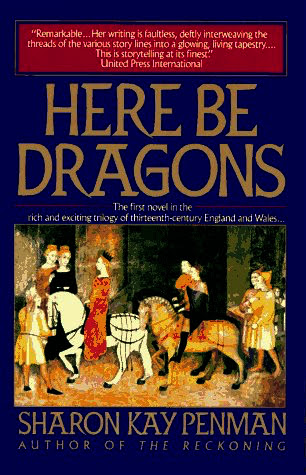
HERE BE DRAGONS


Here Be Dragons, Sharon Kay Penman, Holt, Rinehart and Winston, 1985, 701 pp

How do you choose what to read next? For me it is complex. I have lists, I have plans, I have impulses. I first learned about Sharon Kay Penman from a blogger. Helen at She Reads Novels, my favorite historical fiction blog, has reviewed Penman's books over the years. Since her books are often long, as is this one, I kept putting off reading her.

The impulse came when I learned of Ms Penman's death on January 22 of this year. I then felt guilty for not having read her yet because I would no longer be able to tell her if I liked her books. It also happens that I am gradually making my way through Will Durant's The Age of Faith, a history of the Middle Ages.

Here Be Dragons, set in Medieval England and Wales, is a historical fiction lover's dream come true. Solid research; the evocation of time and place, people and customs; dramatic set pieces that bring wars and kings and feuds and families to life; and best of all to me, equal time given to the women.

The story ranges from 1133 to 1216 during the reigns of several Plantagenet Kings: Henry II, his sons Richard I (the Lion Heart) and King John. Eleanor of Aquitaine appears, wife of Henry II, mother of Richard I and John. She does not come across as favorably as she does in other stories I have read but she looms large.

The focus however is Wales and the exploits of her Princes, including both internal feuds and their attempts to keep the English Kings out of their country. When King John marries off his illegitimate daughter Joanna to the powerful Welsh Prince Llewelyn, in an attempt to secure a truce, the stage is set for a grand passion fraught with conflicting loyalties.

I spent many days reading Here Be Dragons. I was never bored. In fact, I was spellbound. I love studying history and then reading the historical novels that bring the key figures and the attendant families and personal struggles down to the everyday particulars.

This was a perfect example of that with a passionate love story that includes great sex and stormy emotions but is never overdone. I will read more by Sharon Kay Penman. She wrote 13 other books!

Have you read this author? If so, which ones are your favorites?

Monday, March 22, 2021

MY YEAR ABROAD


 My Year Abroad, Chang-rae Lee, Riverhead Books, 2021, 498 pp

This is Chang-rae Lee's sixth novel. I have read every single previous one and loved each one in different ways.

I loved My Year Abroad for several things: the smart, sassy and delicious writing; the hero Tiller and his viewpoint as an Asian/American young man; the absolute richness that Chang-rae Lee brings to all his novels.

Let's go right to Tiller. In many ways he is a mess and yet he is wide open to experience. He has a secret sorrow and is so emotionally vulnerable I just wanted to give him hugs all the time. He is so game and willing when he follows the other main character, Pong the Chinese/American entrepreneur, into Asia. He just keeps trying to be whatever Pong seems to see in him. Many wild adventures ensue, seemingly millions of meals, predatory men and women of all levels of Asian society, and scenes that are barely believable. 

There is an alternating time line in the story concerning Tiller's life in New Jersey, both before and after his year abroad. This was somewhat annoying except by the end I realized the author did me a favor. No matter the horrors Tiller experienced in that year, you know he made it through and you are shown his inner strengths in the kindest way possible.

That last paragraph may sound like a spoiler but it is not because you know all along that he did survive. The wonder of the book is that you still worry he won't.

The smart and sassy aspect includes Lee's deftness with the way college age Americans speak and behave. Also the exact truths he writes about our modern times, stereotypes, global trade practices, the effects of capitalism as a global phenomenon, all done in emotional yet humorous ways.

In case you are thinking this is a lot to unpack, you are right. You will know quite soon in the book whether it is your kind of story or not. It certainly was mine.

Sunday, March 14, 2021

BIRDS OF AMERICA


 Birds of America, Mary McCarthy, Harcourt Brace Jovanovich, 1965, 344 pp

Never would I ever have guessed that I would love so much this novel from 1965. I should not have been that surprised. Mary McCarthy is one of my favorite female 20th century writers, so intelligent, such sharp humor.

Peter Levi is the son of a Jewish historian, the stepson of a Jewish scientist, the son of a thrice married Anglo Saxon Protestant mother who is also a world famous harpsichordist. He passed his younger years being shuttled between New England and Berkeley, CA. He was in love with his mother as a child. By the end of the book, when he is just 19, he still loves her deeply but is aware of her flaws.

I suspect that a great deal of why I was so taken is the time period. Peter grew up in the same years I did. My parents never divorced but my father was an armchair intellectual, my mother had been an aspiring organist. They were both liberals to the end and encouraged me to be well read, well educated, and intelligent.

Peter is a bit awkward socially. He studies philosophy in college. For most of the novel he is in his junior year at the Sorbonne in Paris. He loves the natural world, is in favor of the Civil Rights movement and agonizes continually about how to be. Most of all, he is against war, the Vietnam War in particular, and has the draft hanging over him, as did all the young men I knew at that age.

How do you write a coming of age tale that is emotional, political, philosophical, and traces so delicately the mother/son relationship, all at the same time? How do you create a woke young man in the latter half of the 20th century? How do you breathe life into such a worldly yet confused character? Read The Birds of America and learn.

Wednesday, March 10, 2021

SOLARIS


 Solaris, Stanislaw Lem, Harvest Books, 1970, 204 pp.

[Translation note: Solaris was written in Polish and published in Poland in 1961. The Harvest edition of 1970 was translated from the French by Joanna Kilmartin and Steve Cox. Stanislaw Lem pronounced the French translation "poor." In 2011, Bill Johnston published the first and only translation direct from the Polish to English.]

Solaris is the third of three books I read in February that have a Polish connection. The first was the historical novel Poland by James Michener. The second was Drive Your Plow Over the Bones of the Dead by Olga Tokarczuk, set in a 21st century Polish village. Solaris is by a Polish author but is set in space. This little challenge left me giddy.

I read Solaris because it is an iconic sci fi novel published in 1961 just as the space race was taking off. I read the "poor" Kilmartin/Cox translation mentioned above, not knowing until the other day that there was a better one. That may explain some oddities I noticed.

If you are interested here are two links with more about Stanislaw Lem and the two translations.

Even so, it is an amazing tale about a station on Polaris, a planet orbiting two suns and covered mainly by an ocean, possibly a sentient body of something similar to water. This ocean functions as a sort of massive brain with the power to create psychological changes in the Earth scientists who come to study it.

The novel opens with the arrival of Kris Kelvin, a trained psychologist and astronaut, who finds the station in disarray with two of the remaining astronauts acting quite deranged and a third dead. Kris is a strong, no nonsense character, brave and deliberate. Soon enough he too begins to suffer from what may be hallucinations but may be something else.

I did enjoy and admire the story. It dawns on any reader who has read much science fiction that Lem did not write a standard sci fi tale compared to American works. His book is also allegorical, humanistic instead of militaristic, and satirical about the whole space project as it is playing out on Earth. He seems to be making an examination of what may lie beneath man's quest to find life on other planets.

Each character has brought his personal psychological baggage to space. The ocean on Solaris appears to have the purpose of revealing the suppressed emotional darkness of that baggage to the spacemen, causing what appear to be hallucinations of people from each one's past.

So very creepy and disconcerting but also exciting. You wonder who will succumb and who will survive. Kris Kelvin tells this story of how he came to penetrate the purposes of the ocean. Did he? Or did he go insane? The end of the story is a somewhat murky yet somehow satisfying conclusion.

Two movies have been made from this translation. One in 1972 by Andrei Tarkovsky and one in 2002 by Stephen Soderberg, starring George Clooney. I saw one of them, not sure which, several years ago and came away not understanding what I had just watched. I have requested the 1972 movie from Netflix. 

Now tell me of your Solaris encounters, if you have any.

Sunday, March 07, 2021

DRIVE YOUR PLOW OVER THE BONES OF THE DEAD


 Drive Your Plow Over the Bones of the Dead, Olga Tokarczuk, Riverhead Books, 2019, 274 pp (originally published by Wydawnictwo Literackie, Krakow, Poland, 2009; translated from the Polish by Antonia Lloyd-Jones.)

When I reviewed Poland  by James Michener, I mentioned two books I planned to read by Polish authors. This is one of them and is the third novel I have read by Olga Tokarczuk. She is my favorite Polish author.

"Drive your plow over the bones of the dead" is a line from William Blake's The Marriage of Heaven and Hell. Janina, protagonist of this novel, has many interests, one of which is working with a friend to translate William Blake into Polish.

If all of that sound obscure and scholarly, the novel is anything but. Instead it is a murder mystery, even a thriller. Men in Janina's village are turning up dead. It looks like murder but the police are not doing much to apprehend any suspects. Janina's attempts to provide evidence in the form of letters to the police chief are almost comical, making her appear to be an aging crank who is possibly losing touch with reality.

Her voice as the first person narrator of the story is unmistakable. "I am already at an age and additionally in a state where I must always wash my feet thoroughly before bed, in the event of having to be removed by ambulance in the Night." She despises her given name and has "afflictions" that can send her to bed for days. I can relate to that!

She is also an accomplished astrologer and does the charts of everyone she knows by which she predicts what will happen to them. When she is well she has incredible energy and strength. Her escapades in the village bring the sense of a small 21st century Polish town on the Czech border to life.

I won't say more because I would certainly spoil it for future readers. I found it all so entertaining with unique characters, some of whom reminded me of my interactions with New Age friends and my own past as a nonconformist hippy.

This is the third novel I have read by Tokarczuk, winner of the Man Booker International Prize and the Nobel Prize. Her latest novel, The Books of Jacob, historical fiction featuring a Polish Jew who claimed to be the Messiah, is due in English in early 2022. I can hardly wait.

Thursday, February 25, 2021

AFTERLIFE


 Afterlife, Julia Alvarez, Algonquin Books, 2020, 256 pp

I read this for my One Book At A Time reading group. I loved it.

I have a vague memory of having read How the Garcia Girls Lost Their Accents, this author's first novel, about four sisters adapting to New York City after being uprooted from their Dominican Republic home. All I remember is that I did not like it much, found the sisters too flighty and self-involved. I think that says more about me as a reader back then than about Julia Alvarez as an author.

Afterlife, her first adult novel in over 14 years, centers on Antonia; a senior woman, a retired professor of literature and a devastated new widow. This is an author writing what she knows (some of the story feels autobiographical) and what she doesn't know (she still has her husband.)

While Antonia is trying and mostly failing to deal with her bereavement, she is hit from all sides by the suffering of others, including her three sisters and an undocumented pregnant Mexican teen who shows up in her neighborhood. With all these distractions and calls upon her to assist others she finds a way to go on living, with new purpose and hope.

I loved the writing, which is as light as a backyard bird and as full of emotion and imagery as a poem. Antonia's mind and soul are full of literary references from the books she has read and taught for most of her life. Those insights provide sustenance but also require realignment when brought to bear on real life.

I can't say I loved all the characters because many are unlikable but I found empathy for them. Those sisters are just as self-involved and out of control emotionally, while equally bound by their loyalty to each other, as the Garcia sisters were.

All is leavened by moments of almost laugh-out-loud humor, keeping the dark tragedies of the story from overwhelming the tale. I felt cared for as a reader by this largehearted author.

Depending on the day you ask, I still sometimes feel like a 40-something woman but in truth I am in the same age bracket as Julia Alvarez. That may be why I felt her story so deeply. Work, family, politics, loss, can all be so disappointing. Novels like this keep me going when I need encouragement.

Sunday, February 21, 2021

POLAND


 Poland, James A Michener, Random House, 1983, 556 pp

This is the 15th book I have read by this master of historical fiction. Though it has been on my shelves for many years I read it at this time because I had two other novels coming up written by Polish authors. I became interested in the country and its authors through a member of The Tinies reading group who is of Polish descent and has visited there several times. I wanted to learn more.

Michener begins: "In a small Polish farm community during the fall planting season of 1981, events occurred which electrified the world, sending reverberations of magnitude to capitals as diverse as Washington, Peking and especially Moscow." Who knew?

In 1981, Poland was still under Soviet Communist rule. The farmers of that small community sent a representative to meet with Communist officials proposing a farmers union in order to better their economic status. They were denied but the meeting was a turning point in Poland's fight to free themselves the Soviet Union.

In Chapter 2, the story jumps back to 1200 AD in the times of Genghis Khan and proceeds forward, following members of three families and their descendants to show how Poland reached that 20th century crisis. It is a tale of Nobles, Kings, Clergy, merchants, Jews, small land holders and peasants.

Once a vast land, areas of Poland have been carved away over time by the barbarian Tartars, Russia, the Austro Hungarian Empire, and Germany. The propensity of their Nobles to hang on to their lands, castles and riches plays out in relation to what amounted to slavery among the peasants, or serfs as they were then called. For centuries self-interested interactions between the Nobles and surrounding hostile nations led to wars and lack of a strong government for Poland. 

Such a tempestuous journey from Medieval to modern times makes for absorbing reading. Wars and battles, victories and losses, bravery and love of country, artist and musicians (Chopin), a majestic landscape of rivers, mountains and forests. Always the backbreaking work of serfs to keep the population fed and served and to provide cannon fodder for the wars.

Because the novel was published in 1983, plenty has happened for Poland since. The current government has been free of the Soviet Union for several decades now but is right wing and conservative. I looked up some of the history of those decades. Though the country is more sound economically, a strong Catholic presence and the tone of the government impacts women's rights and the freedoms of writers. 

It is good to have the long range picture, including the horrors of WWII, the Nazi concentration camps, the Soviet influence after that war, and the ongoing conflicts between Christians and Jews in Poland. In fact, it is difficult to understand the current news about any country so foreign to Americans. Michener's book filled in the gaps in my knowledge and was well worth spending a week to read.

Friday, February 19, 2021

LAND OF BIG NUMBERS


 Land of Big Numbers, Te-Ping Chen, Mariner Books, 2021, 233 pp

It is widely known that I have not been a fan of short stories. By reading more of them lately I am discovering what makes a short story satisfying for me, though I am not ready to articulate that clearly yet.

Land of Big Numbers was a miracle. Every story in this collection is great. The author is, I believe, Chinese-American and a journalist who spent four years as a Beijing-based correspondent for the Wall Street Journal. She seems to have soaked up the essence of 21st century Chinese life.

Each story grabbed me from the first line. It was as if the characters were right in the room with me. Tension builds quietly yet relentlessly tale by tale. I found myself almost holding my breath until I learned what would happen, each time for 10 stories. The theme tying them together is the better life for Chinese people under the current government at the cost of some of their freedom. A heady concept created by this author without outright judgement. 

Thanks to The Nervous Breakdown Book Club for selecting Land of Big Numbers as the January 2021 book. Thanks to Brad Listi at the Otherppl podcast for a penetrating interview with Te-Ping Chen. I will be watching for more from this author.

Monday, February 15, 2021

EXPOSING THE PAST


 Exposing the Past, Alice Zogg, Aventine Press, 2020, 223 pp

Have you ever come across a stranger who looked just like you? I once did many years ago. I saw "myself" across a crowded ballroom. It was extremely disorienting. Was I where I was standing or was I on the other side of the room? I never saw her again. I was not sure I wanted to. I hoped I had imagined the whole thing.

Not so for two of the main characters in Alice Zogg's latest stand alone mystery. Sherry Rinaldi saw her Doppelgänger in the mirror next to her in the ladies room while on vacation on Maui, Hawaii. The two women spoke, joking about being twins. They exchanged first names, discovered they both lived in California; Sherri in Pasadena and Kirsten in San Diego. Then they went their separate ways.

Sherri could not let it go though and despite her husband's strongly worded advice, she pursued the connection. She tracked Kirsten down and eventually they learn the truth but not until another woman dies.

Exposing the Past is an expertly plotted mystery, very up-to-date with DNA testing, cell phone texting and much driving up and down the Interstate 5 freeway. The two women found their answers back in the 1970s.

Alice Zogg is my friend. We met shortly after she had self-published her second book. I reviewed that one for a local paper and she has given me a copy of each new book when it comes out. We meet for lunch occasionally and talk about writing. She has 15 books to her credit now. I have 15 years of blogging about books to mine and a book I am always working on but feel I may never finish.

Life is wonderfully strange but fiction can be stranger, as it is in Exposing the Past. There can also be danger in writing about the past. My book is autobiographical in part and I have spent some uncomfortable days, even weeks, as I look at my past and that of the world. Alice too has written a memoir, mainly for her descendants, though she let me read it. Of course, she wrote hers in just a few months!

Thursday, February 11, 2021

TO MERVAS


 To Mervas, Elizabeth Rynell, Archipelago Books, 2010, 192 pp (originally published as Till Mervas by Albert Bonniers Forlag, Stockholm, Sweden, 2002; translated from the Swedish by Victoria Haggblom)

I have been neglecting my Archipelago Books shelf for too long. I must say that every book I have read from this excellent publishing house of translated literature has provided great reading. To Mervas was no exception.

Marta, a solitary middle-aged Swedish spinster with a troubled past, receives a letter from her lover of over 25 years ago. He writes, "Marta, Mart! I'm in Mervas. It is not possible to get any farther away. And no closer either. Your Kosti."

Though I have never been to Sweden, I have read enough novels set there to have a feel for the country. Never had I heard of Mervas. I learned that it is a region of abandoned mining in the far north.

Marta's journal entries from the November day she receives Kosti's letter, reveal her childhood (brutal), her affair with Kosti (aborted by a huge argument), and her sad life ever since. She struggles with her fear of moving out of her lonely existence and a conviction that going to find Kosti is her last chance to make something meaningful of her life.

The writing is crystal clear, both in the telling of Marta's inner turmoil and in describing the journey she does finally make to Mervas. Elisabeth Rynell is both a poet and and a novelist. To Mervas is her third novel and the first to appear in English. 

It is a story of hope. Even a woman like Marta, who has suffered from terrible trauma and losses, can pull from her suppressed memory the moments when she had strength and so venture again into life.

I loved this novel from its gorgeous cover to its final page.

Saturday, February 06, 2021

THE DARKEST EVENING


 The Darkest Evening, Ann Cleeves, Minotaur Books, 2020, 299 pp

I read this mystery set in Northumberland for my Bookie Babes reading group. It is the ninth in a series featuring Detective Inspector Vera Stanhope. She is a delightful curmudgeon, middle-aged, competent, single and not thin. I did not feel hindered by not having read the earlier books in the series.

It was a great January read filled with snow and cold and icy roads back in the hills. A manor house surrounded by farms traps Vera's team and the inhabitants due to a blizzard. 

Vera's family home is the manor house, though because of her loser father, she is on the underdog side of the family. Lots of class issues as you would expect in Great Britain, though cell phones (with spotty reception) as well as some rowdy teens put the reader in the present.

A murder, a plucky toddler, questions about parentage and rocky marriages all give plenty of red herrings. I never did figure out who the murderer was until Vera did. I was entertained and not one thing bothered me.

I probably won't get into the earlier books, at least not right away, but it is good to know about if I'm looking for a new series to love.

Have you read Ann Cleeves?

Saturday, January 30, 2021

MIGRATIONS


 Migrations, Charlotte McConaghy, Flatiron Books, 2020, 256 pp

This is the best novel I have read so far in 2021. The big idea behind the story is climate change. Set in the future, Earth's oceans are fished out, wild animals have all but disappeared, insects and birds are dwindling rapidly.

The culprits in all this demise are humans. Unless we can change our ways we will ourselves follow since we have decimated the very elements needed to survive. Thus it must be humans who populate the story.

Charlotte McConaghy had already published three sci fi/fantasy series in Australia prior to this international debut. She knows how to create awesome female characters so it is no surprise that Franny Stone, damaged and nearly broken, is also the heroine who drives this epic tale.

Able to love but unable to stay, her search for a way to heal the earth takes her on a journey to track the last Arctic Terns on their migration from Greenland to Antarctica. She finagles her way onto a fishing boat and then convinces its equally damaged and broken captain to take that journey. The opening chapter where Franny meets the captain and his crew is so gripping, I wondered where the author could go after that.

The answer is everywhere, from Ireland to Australia, on the high seas and into the human heart. All the while the mystery of Franny is gradually revealed. When a person has nothing more to lose, when she must engineer her own redemption, there are no limits to her daring.

The writing is at once cinematic and intensely personal. Never does the pace falter. On every page, I wanted desperately to know how the book would end. When it did, I wanted it to go on. I wanted to stay with Franny forever.

Wednesday, January 27, 2021

RED PILL


 Red Pill, Hari Kunzru, Alfred A Knopf, 2020, 304 pp

This is an important novel about today's world, about intrusion into our privacy, about a sort of epic battle between left and right in politics, about the ways in which such conundrums wear us out and down.

The title refers back to the 1999 film, The Matrix. It is about a choice: the red pill reveals life-changing truth, the blue allows a state of blissful ignorance. (I did not remember this trope from the film so I plan to watch it again.)

The novel opens with a middle-aged writer, happily married, father of a three year old daughter, but stuck as a writer.

"It is when you first understand," he says of middle age, "that your condition...is not absolutely mutable, that what has already happened will, to a great extent, determine the rest of the story."

In an effort to break through his writer's block, he travels from Brooklyn to Germany on a fellowship. He expects to have weeks of uninterrupted quiet and to work on his next book. 

Instead, he finds a regimented scene where he is expected to write at a desk in a large communal room surrounded by the other writers. He immediately becomes uncomfortable and gains a reputation as odd man out and troublemaker for resisting the rules.

He hides out in his room, binge-watching a violent cop show, and not writing. He takes walks around the town of Wannsee, historically the location where the Nazis planned the final solution. In the dining area he meets Anton, the writer of the cop show and perceives the man to be his nemesis. Eventually an obsession forms that Anton is living in the writer's mind. His actions become increasingly erratic.

I am drawn to descent into madness tales, perhaps because I have been on that brink a couple times myself. Kunzru has cleverly written one these tales but creates a parallel one; society and an individual making similar descents.

This creepy beginning ramps up into a type of psychological thriller. After a stint in a psych ward and finally being rescued by his left-wing lawyer wife, the book ends on the night of the 2016 election as he and his wife throw a party to watch the election results come in. Yes, that night!

I found the end of the book possibly a bit soft and improbable. As I thought about it over several days, I realized that it is so very Hari Kunzru that the nature of his story should be set against an improbable ending. After all, at this point in history we have little idea of where we are headed. 

Not a feel good novel but certainly an illuminating one.

Saturday, January 23, 2021

MYSTERIES AND THRILLERS MINI REVIEWS

When January 1, 2021 finally rolled around I was in a state of despair with nothing to look forward to but January 6 (which brought only more anxiety) and January 20. Finally the longest wait ever was over. Meanwhile I decided to sink into the most distracting reading I could find. For me that is mysteries and thrillers where the pages fly by, justice gets done and the bad people get what is coming to them. It was a good decision! Here are some short reviews of those, for me, sanity saving books.


 The Searcher, Tana French, Viking, 2020, 446 pp

I would categorize this one as a literary crime novel. Tana French has always embedded her excellent plots in a literary style. I have read all of her previous seven books and appreciate how she has branched out in each one.

A former Chicago cop, after a divorce and deep disillusionment with law enforcement, has moved to Ireland. While fixing up his cottage and getting to know the local people and customs in his remote village, he gets pulled into a missing person can by a curious child who shows up on his property.

Though the story takes a while to get going, Tana French builds tension on every page until all the clues come together. The book is a study in culture clash, small town secrets and sad truths. I loved it.


The English Girl, Daniel Silva, HarperCollins, 2013, 473 pp

The 13th book in Daniel Silva's Gabriel Allon series is a political thriller. Allon is an art restorer in his public life but also works as an assassin and spy for Israeli intelligence. He is a master at all three roles.

Over the course of the series, Allon has forged relationships with both British and American intelligence. In The English Girl, he is called in via MI6 to find the missing mistress of the (fictional) current Prime Minister of Britain. The criminals behind the kidnapping of Madeline Hart figure the British governing party will pay a huge ransom to protect their guy at 10 Downing Street from scandal.

When Allon penetrates the operation, he finds himself once more at the potential mercy of some ruthless enemies he has made over the years, Russian enemies that is.

Even after 12 books this author managed to raise my heart rate while he began to set up a possible new future for his hero. Also intriguing was how deeply the story penetrated into Putin's true intentions for his country and the rest of the world, intentions that nearly destroyed our democracy over the past four years, intentions he has had since he became Russia's leader in 2012.


Mona Lisa Over Drive, William Gibson, Bantam Books, 1988, 308 pp

The final book in Gibson's Sprawl trilogy is a cyberpunk thriller. He gives us more of his groundbreaking unleashing of cyberspace onto the world of fiction. He exhibits some new fiction chops including deeper characters and an even more nuanced look at the machinations of the powerful Japanese underground, the uses of celebrities, and the mysterious beings behind artificial intelligence. 

His story brings back some characters from the first two books (Neuromancer and Count Zero) while adding Mona with her murky past, a new sort of console jockey, and an endearing but mentally challenged dude named Slick Henry who broke my heart.

After over 300 pages of non-stop action comes the intriguing ending meant to explain the history of these stories, the "why" of When It All Changed. It did not explain as much as it cliff-hangered me.

Will the next trilogy, The Bridge Trilogy, give more answers? Probably the plot will only thicken.


Hard Truth, Nevada Barr, G P Putnam's Sons, 2005, 324 pp

I ended my spree with the 13th book in Nevada Barr's mystery/crime series, all set in National Parks. I started reading this series five years ago and only have six more to go. I am getting there!

Park Ranger Anna Pigeon arrives at Rocky Mountain National Park for a temporary assignment as District Ranger in the midst of a search for three missing girls. On her first day two of the girls emerge from the woods, dressed only in ragged filthy underwear, traumatized and close to starvation. One girl is still missing. The two are rescued by campers but claim to remember nothing.

In a series where the plots are always complex and twisted, Nevada Barr has kicked it up yet another notch. Included in her tale are a wheel-chair bound paraplegic woman, a fringe Mormon community, mistaken identities, and a serial killer who specializes in harming children. 

Evil spreads through the breathtaking beauty of the park. Danger, even to animals, lurks in every valley, over the next peak, and even in the rangers's cabins. This is almost a horror novel.

I must admit that the physical and psychological damage done to the female children was hard to take. Be warned. Anna Pigeon's canny investigating and fearless strength provide much needed balance.


Have you read any of these thrillers? Who are your favorite thriller writers?

Tuesday, January 19, 2021

WILD SEED


 Wild Seed, Octavia Butler, Doubleday Books, 1980, 253 pp

This is the last book I read in 2020, for The Tinies reading group. We have not yet met to discuss it because one of us is ill (not COVID thank goodness) so I can't report on what they thought. I found it a tricky book to review because it contains multitudes but here goes.

Wild Seed is one in a series called Seed To Harvest. This book in that series is a somewhat alternate history beginning in Africa in 1690. Slavers are industriously capturing natives and shipping them off to America. Anyanwu is a healer, a shapeshifter, and is 300 years old. She does her best to protect her village from the slavers.

Doro comes upon that village. He had been inspecting what he calls his seed villages. What is a seed village? It is the crux of the whole story. Doro is over 1000 years old. When a body he inhabits becomes old or less useful, he jumps into another one after killing the previous owner. Just to give you some idea of the character. 

Doro has been engaged in a centuries long project to breed people of his race, developing individuals with superior powers and traits. He has brought many of these people to the New World, not as slaves but as almost mystical beings who can fight the powers of oppression.

Upon meeting Anyanwu, he recognizes her special powers and wants to use her to breed more people with such powers and add them to his groups. He also is aware that she is what he calls a wild seed and will need careful handling. So begins a power struggle between the two. Doro may be ruthless but Anyanwu is in some ways the stronger of the two because she has certain characteristics that he is lacking.

To America they go. Two hundred years go by bringing the story to 1840, before the Civil War but during the beginnings of Abolition. Doro and Anyanwu remain locked in their struggle. He demands complete obedience, she refuses to submit fully. She bears many children and suffers many tragic losses but fills a role that Doro cannot: healer, mother and a bit of a check on Doro's power.

The extremes of fantasy and the levels of violence in this tale of visionaries and psychics ride on a knife-edge of madness. It could be too much for some readers. I was fascinated and could not look away. Anyanwu is a heroine of mythic proportions and I had to know if she would survive under Doro or if she would escape.

A word about this series: I read Wild Seed in a 4 book collection, Seed To Harvest. The books in the collection are not arranged in order of publication. I searched for the reason. This collection was published just a year after Butler's death. Some sources say that she wanted the series released in the chronological order of the story, even though she wrote that chronology out of order. Originally the series was called the Patternist Series after the first published book, called Patternmaster. That novel is the last in Seed To Harvest.

From what I could find, readers are divided on the issue of whether to read the 4 books in publication order or chronological. Since I have seen this kind of thing happen with other science fiction series, I decided to go with the chronological option as presented in the collection. I will keep you posted as I read the other three books.

It looks like the four novels get into even wilder scenarios including a far future cosmic invasion! Can't wait!!

Tuesday, January 12, 2021

WATER, WASTED


Water, Wasted, Alex Branson, Rare Bird Books, 2020, 283 pp

The final Nervous Breakdown Book Club selection of 2020 is possibly the weirdest novel I have ever read, but there was a lot I liked about it. As in Lord The One You Love Is Sick, it is set in a small town, this time in Missouri, right on the Missouri River.

The author grew up in Missouri, he likes to work for nonprofits that actually help people, and he runs an unusual podcast where every episode is the first episode without any sequels, or something like that. 

Central to the story are a middle-aged divorced couple, Barrett and Amelia, who lost their only child, a daughter named Edi. That loss destroyed their marriage leaving them each to become rather isolated eccentrics. The violent death of a teenage boy touches both of them in different ways but prompts them to reconnect and reflect on Edi's passing. 

Several other odd characters of the town turn out to have their own connections to Barrett, including an involved story concerning lots of dogs, a talking goat, a Bigfoot-like entity that ravages the countryside, and a G-man (supposedly a government agent who acts more like an alien.)

The story circles around, back into the past, and through many instances of the Missouri River flooding. During her short life, Edi wrote several fantasy books in which the goat, Bigfoot and the G-man figured. When these entities show up in town, Barrett and Amelia read Edi's books for the first time, trying to make sense of it all. What did she know and was it connected with her death?

I only recommend the novel to those who truly love the weird. It is like China Mieville decided to write a story set in small town America. I can't quite explain why I liked it, but I did. It made me think of some of the people and ideas that seem to have taken over our country in recent years and wonder if they didn't come out of a speculative genre or some parallel universe.

Thanks once again to another Los Angeles based indie publisher, Rare Bird Books, and to The Nervous Breakdown for sending the book out. 

Sunday, January 10, 2021

LORD THE ONE YOU LOVE IS SICK


 Lord The One You Love Is Sick, Kasey Thornton, Ig Publishing, 2020, 229 pp

In the November, 2020, selection of The Nervous Breakdown Book Club, from indie publisher Ig, a slice of life plays out in a small North Carolina town. It is an enlightening read in terms of the supposed conflict between Red states and Blue states. I say supposed because it is my belief that Red vs Blue is a political construct that smothers the actual complexity of American lives.

Kasey Thornton grew up in a town similar to the one she writes about. She still lives in that community. She put this debut novel together by collecting the stories she had written about life in her town. The book reads like a novel, at least it did for me.

After the fatal heroine overdose of his best friend, Dale's life becomes almost impossible. He feels guilty for abandoning his friend, he is training to be a cop, and his marriage is on shaky ground. As all of this plays out, other residents of the town come into the story.

The drugs, the poverty, the vanishing economy, and all the secrets held combine into an explosive mix. The adults are facing down cancer, diabetes, mental illness; the kids are living with instability or abuse; the women are trying, and often failing, to stand by their men.

Yet there are strong religious beliefs and codes of behavior that include not facing reality. I have found this conundrum in much of Southern fiction: Faulkner, Flannery O'Connor, Eudora Welty, Robert Penn Warren, Jesmyn Ward, Carson McCullers and more.

These issues and conflicts are probably present in any community. The title here comes from the Gospel of John in the story of Lazurus. When he falls ill, his sisters Mary and Martha send a message to Jesus: "Lord, the one you love is sick." If you were raised on the Gospels you know the rest.

Even Jesus had a secret plan.