Friday, July 01, 2011

MOUNTOLIVE


Mountolive, Lawrence Durrell, Dutton & Co, 1958, 318 pp


Durrell's Alexandria Quartet is like a kaleidoscope, always refracting his characters and story in each succeeding book. In Mountolive, the third volume, the sense of political intrigue that began in Balthazar takes on an even deeper character. Mountolive is a young British diplomat in training when he meets Leila, who takes him as a lover on the advice of her crippled husband.

As we know already from Justine, Leila is mother to Nessim, Justine's husband. Now we learn that both women take lovers for political reasons. By the mid 1950s, it becomes clear that oil, Jews and Israel are involved in the story. Suddenly it all makes sense, because the main story of Great Britain after WWII was the nation's struggle to hang on to an empire that was in fact over.

But what a brilliant twist Durrell has achieved; taking what appeared to be a love story steeped in the mysterious city of Alexandria and turning it into a post Commonwealth critique of the underlying intentions of nations, leaders, diplomats, fanatics and businessmen. He reveals all of it like a Pandora's Box.

I read this book in late winter, 2011 during the days of the uproar in Egypt. It felt like I was reading exactly the right book.


(Mountolive is available in paperback by order from Once Upon A Time Bookstore.)


Wednesday, June 29, 2011

COMPOSED: A MEMOIR


Composed: A Memoir, Roseanne Cash, Viking, 2010, 241 pp


Roseanne Cash has a voice all her own. I have been a fan of her songs beginning with her 1993 album, The Wheel. I never listened to her early commercially successful stuff which was mostly Nashville influenced country music. In her memoir I learned that it took her until 1990 to find her true writing voice as a songwriter. Sure enough, that is when her commercial appeal faded away, but also when she began garnering huge critical recognition.

I think she is a better songwriter than prose writer. I enjoyed learning about her life but the way she tells it is subdued emotionally and a little too disjointed, even for a memoir. But having been a songwriter myself that makes sense to me. In a song, you must distill a story and its emotion into very few words: a few verses and a chorus. Even a short story has thousands more words than a song, so it is the opposite creative flow. You expand a story and its emotion into lots of words. It is hard to make the switch and not many songwriters have done so successfully.

Along with other readers, I wanted to know more about her marriage and break up with Rodney Crowell. She is quite reticent about all that. I felt enlightened by her accounts of the relationship between her and her father Johnny Cash. She might have shared too much about her physical woes.

The last chapters are mostly about sickness and death, so the mood was somber. Despite her successes, her struggles, her ultimate happiness with John Leventhal, I couldn't help thinking that she has had an almost life. But then, maybe most of us have almost lives that don't measure up to the dreams we once had.

Bummer. But I still listen to all her later albums.


(Composed will be released in paperback on July 26, 2011. It is available by order from Once Upon A Time Bookstore.)


Tuesday, June 28, 2011

METHUSELAH'S CHILDREN


Methuselah's Children, Robert A Heinlein, Gnome Press, 1958, 276 pp


Heinlein returns to writing for adults here with the expansion of a story originally serialized in Astounding Science Fiction in 1941.

The Howard Families are descended from a man who got rich during the California Gold Rush and left his money to be used for research into the prolongation of life. This goal was realized by his trustees providing financial encouragement to the grandchildren of long-lived persons to marry and have children. By the 22nd century, descendants have a life expectancy of 150 years, but their existence is a secret from the rest of society.

Great plot set up, because of course when they decide to reveal their secret all hell breaks loose and the Families must escape Earth in search of other galaxies and a new planet. The remainder of the story concerns their adventures in space and the events surrounding their attempts to live on two different planets. Heinlein covers contact with alien races, mad scientists, beleaguered administrators, telepathic mutants and questions of time in deep space.

I liked the men who wore kilts (yes, really) and the many hairs breath escape scenes. I thought of Greg Bear's Darwin's Children and The Sparrow by Mary Doria Russell. Now we also have Embassytown by Mieville. All of these later books riff on some of the key elements in Methuselah's Children. Also detectable were ideas that will show up in Stranger in a Strange Land (1961), which answers the question I had in my review of Have Spacesuit, Will Travel. Best of all was renegade hero Lazarus Long.


(Methuselah's Children is out of print. I found my copy at The Bestseller Bookstore, a used bookstore in Burbank CA with a huge sci fi section.)


Sunday, June 26, 2011

KRAKEN


Kraken, China Mieville, Del Rey, 2010, 509 pp


I finished Kraken over two weeks ago and had to return it to the library before I had a chance to write about it. Now I have to dig my thoughts out from beneath the several books I have read since then.

Although I have become a raving fan of China Mieville and will read the rest of his earlier books as well as anything he writes in the future, Kraken did not move me as much as either The City & the City or Embassytown. It was too something: too long, too drawn out and disjointed. It was also an insane story about the capture of a preserved giant squid that was the god of a religion.

As usual in Mieville, there is a reluctant hero and plenty of good ideas. My favorite character was the female cop, whose name I now do not remember. I also like the little god who could only exist in statues, including gargoyles and Star Wars plastic dolls.

I think you'd have to be a dedicated Mieville reader to get through Kraken. At least that is how I got to the end. The end is quite good and I was worried about that.

Go ahead. Hit me with your comments, disagreements or whatever.


(Kraken is available in paperback by order from Once Upon A Time Bookstore.)


Thursday, June 23, 2011

MEMOIRS OF A DUTIFUL DAUGHTER


Memoirs of a Dutiful Daughter, Simone de Beauvoir, The World Publishing Company, 1959 translation, Librairie Gallimard, Paris, 1958, 360 pp


I looked forward to this first volume of Simone de Beauvoir's autobiography with much anticipation, but had no idea how wonderful it would be. Memoirs of a Dutiful Daughter covers the first twenty-three years of her life beginning with her earliest childhood memories. I loved the way she explained the early tantrums that came over her whenever adults attempted to block her efforts to act in an independent, self-realized fashion. Apparently she was born with the sense that she was an individual who mattered and had the right to follow her own ideas.

Her upbringing was bourgeois Catholic, though her family was by no means wealthy. She went to Catholic schools, was trained and guarded as a young girl by a devout, socially conservative mother, yet stimulated by her father's love of the theater. Although she was kept close to home and inculcated with fears about bodily functions, passion, men and sex, Simone had always a brilliant inquiring intellect. She read and studied incessantly all throughout grade school, high school and college, entering the Sorbonne as one of the few female philosophy candidates. Every drive she had was sublimated into mental activity. She was almost twenty before she went out on her own to bars, plays, movies, at which point she went a bit wild but never experienced more than a kiss from a male.

As she relates her female friendships, her infatuation with her cousin Jacques, her quest to understand life through philosophy, I was enthralled by the combined emotional, spiritual and intellectual fervor which imbued every minute of her coming of age. The loss of her Catholic faith and her attempts to understand her own mind, passions and aspirations were as exciting to me as her tortured relationship with her best friend Zaza.

I doubt that I will ever reach the intellectual heights of this amazing woman, but I have always dreamed of doing so. As I mentioned in my review of The Second Sex, it blows my mind that Simone de Beauvoir was of my own mother's generation yet our mothers were so much alike. It is almost true that she went through my life a generation earlier in another country, in Paris of all places. I am lucky that she always kept a journal and could write so movingly about her life.


(Memoirs of a Dutiful Daughter is available in paperback by order from Once Upon A Time Bookstore.)

Wednesday, June 22, 2011

THE TIGER'S WIFE


The Tiger's Wife, Tea Obreht, Random House, 2011, 338 pp


After much pondering, I have decided I need to read this book again someday. There was so much hype about the novel, the author, her youth, her background, on and on. I may have gone into it expecting something I did not find.

What I did find was beautiful writing. Let's do the page 99 test and take the first couple sentences: "You lose sunlight, and suddenly you are driving through a low cloud bank that is unfurling across the road in front of you. It is anchored to the pines and the rocks above you, to the sprawling pastures that open up below, dotted with ramshackle houses, with doorless inns, distant nameless streams." Nice.

I also found a main character who speaks usually in first person but sometimes in second. She is a medical doctor who believes in modern science but whose surroundings in postwar Yugoslavia are steeped in superstition and wild tales. The tales include a semi-feral tiger, once a zoo animal, who takes a human wife. But this woman is oddly unemotional while telling an emotional story so bottomless that you wonder how people survive life at all.

I liked the writing and the stories. I had trouble with the form which I found unwieldy and hard to follow. If you have read many of my reviews, you know that for me to say a book is hard to follow is really saying something.

The Tiger's Wife needs to be read slowly, in a savoring mood, with the full understanding that, despite having lived in the United States since she was twelve years old and despite having studied creative writing in American universities, Tea Obreht is an Eastern European writer. In a series of reviews and interviews I read at the blog 3 Guys 1 Book, I was enlightened by the comparison of The Tiger's Wife to novels by Orhan Pamuk, Naguib Mahfouz, and Nikos Kazantzakis. So there you have it. I tried to read The Tiger's Wife as a hot first novel by a young American woman. It is not that. When I read it again, I will know what I am getting into.

I can tell you this. About two years ago I read The Cellist of Sarajevo by Canadian author Steven Galloway. It was the only novel I had read about the Bosnian War and it was not bad. In fact, it was horrifying and moving. Still, it was a story told through the lens of a North American writer. The Tiger's Wife comes from a young woman who was born in the midst of that war, whose life and family were disrupted in ways I can hardly imagine, and who is bringing us news of her homeland along with the folk tales of its people.

To me that is worth more than a million newspaper articles, or nightly newscasts, or NPR commentaries. Even if The Tiger's Wife had been a bad novel, which it certainly is not, it was a necessary read for me.


(The Tiger's Wife is available on the new fiction shelves at Once Upon A Time Bookstore.)


Tuesday, June 21, 2011

THE LOST TRAVELER


The Lost Traveler, Sanora Babb, Reynal & Company, 1958


Before I began my Big Fat Reading Project, I was doing my Tree Grows in Brooklyn Project: trying to read all the fiction books in the library by working through the authors alphabetically. Which is how I happened to read The Lost Traveler. That was in 1994 and here is what I wrote in my reading log about the book:

Les Tannehil is a professional gambler with a wife and two kids. This is not a good combination and it finally explodes in family violence with Les on the run from the law. The writing is good, not as dreary as Joyce Carol Oates but almost. One daughter, Robin, comes to understandings about life, love and people. The rest are lost in the shuffle.

Since the book was published in 1958, it later made its way onto my reading lists. Today I looked up the author Sanora Babb and wow! She was raised in the Dust Bowl area and her first novel got bumped just before publication because John Steinbeck's Grapes of Wrath suddenly achieved best seller levels. Her publisher did not think the reading public would buy two books on the same subject!

Here is a great link to the story of Babb's life, which was more varied, exciting and difficult than any novel. Also I read somewhere else that Robin, the female character in The Lost Traveler, was noted as having more strength and free will than was usual in 1958 fiction. Cool.


(The Lost Traveler is out of print but available through used book sellers and sometimes found in libraries.)


Monday, June 20, 2011

ZAZEN


Zazen, Vanessa Veselka, Red Lemonade, 2011, 260 pp


This first novel by Portland author Vanessa Veselka was crazy good. It stands out from almost everything I have read this spring. I reviewed it for New York Journal of Books. Here is my review:

If Bob Dylan had been a female novelist born in 1969, he might have written Zazen. And it is so great when a woman does something better than the man could have done, no matter how cool he is. Vanessa Veselka’s gritty frenetic writing serves up an exciting new flavor among today’s literary menu of MFA influenced prose; not a conventional, well-crafted tale but a streaking flash of barbed satire and 21st century malaise.

Della, raised by hippies, waitressing in a vegan café, lugging a backpack filled with her PhD in paleontology, her shattered psyche and her maps of destruction, begins calling in pseudo bomb threats from prepaid cell phones. She also contemplates leaving the country and in fact books two flights. Her alienation from the society around her calls for a group and a cause she can believe in, but despite an array of similarly distraught friends, she cannot find what she is looking for.

The Buddhist posture “zazen” involves sitting immovable so as to achieve a holistic body-mind framework. Della is obsessed with incidents of self-immolation. She collects newspaper photos and posts them on the walls of her attic room. She learns from her yoga instructor that being able to sit still is the key to burning successfully. The trouble is, nothing in Della’s consciousness stays still for much more than a second. Her internalized state of the world’s insanity-capitalism run amok, continuous war, school bombings and WalMart-manifests as non-stop attention disorder.

Zazen is a powerful novel because it points out the sheer amount of uncertainty and distraction surrounding any person in the modern world. Most of us find ways to shut it out but Della is open to and affected by every bit of it.

The burning question in Zazen is whether revolution could be the answer. Echoing Paul Bowles’ anguish and Tom Robbins’ comedy, Veselka’s answer is unconvincing, but the irony is unmistakable: how did the country that was founded on revolution end up watching 999 cable channels and shopping at WalMart?


(Zazen is available in paperback by order from Once Upon A Time Bookstore. You can also read it online.)


Sunday, June 19, 2011

HAVE SPACE SUIT-WILL TRAVEL


Have Space Suit-Will Travel, Robert A Heinlein, Charles Scribner's Sons, 1958, 276 pp


The Sunday Family Read


This is another of Heinlein's "juveniles", written for a Young Adult audience. Clifford is a young man who wants to go to the moon. In a tradition that spans Ray Bradbury to Stephen Spielberg, Clifford fools around in his mid-western basement, upgrading a space suit he bought by mail order. For some reason I love that. Imagine FedEx showing up in front of your house to deliver your new space suit!

One day he is trying it out in his backyard and winds up in space. With a ten-year-old girl named PeeWee, her rag doll and an indescribable alien creature known as the "MotherThing." Sometimes Heinlein, for all his technical and moral paragraphs that go on and on, just kills me with his imagination.

Plenty of adventure, humor, suspense and science follow and it is a great Heinlein yarn. I know that Stranger in a Strange Land was published in 1961, just three years later than this one. I found myself wondering how he got from a story like this to a story like that in just three years. I think the "MotherThing" is a clue.


(Have Space Suit-Will Travel is available in paperback by order from Once Upon A Time Bookstore.)


Saturday, June 18, 2011

EMBASSYTOWN


Embassytown, China Mieville, Del Rey, 2011, 345 pp


I spent a week immersed in China Mieville's worlds, starting with Un Lun Dun followed by The City & The City and ending with his latest release, Embassytown. Like the heroine of Embassytown, the self-deprecating but brave and competent Avice, who made her mark as an immerser in deep space, I seem to have at least a couple of the talents required for immersing: an ability to stay conscious, not get queasy, make decisions and carry out tasks while completely adrift in the unknown.

Embassytown is unabashed science fiction from an author who has produced award-winning fantasy and urban thrillers. China Mieville is at the top of his game as a writer, having created in his latest novel an almost perfect balance of world building, story telling, characterization and dialogue.


A suburb of the main city on the planet Arieka, Embassasytown is home for the earth people who live there on the outer edge of explored space, administering diplomacy and trade for their colonizing masters. Indigenous Ariekei, known as Hosts, provide the basic necessities of life for the humans. In order to communicate with the Hosts, specially created doppel humans, known as Ambassadors, are required. Two identical twin humans are raised from birth to speak, act and think as one and carry names like EdGar, MayBel and CalVin. They learn to speak Language, the only and always truthful words of the Hosts.


Reading the first third of Embassytown is not unlike visiting a foreign country where one does not know the language or social customs. Once you are oriented on Arieka the remainder of the story flies by. As adrift as you might feel, the orientation is well worth a close reading. There are layers of meaning at work that include much more than a rip-roaring space yarn. Contact and development of understanding with an alien culture, a philosophy of language, the politics of colonization, the building of empires and the impetus, the planning that become history are just some of these layers.


Avice Benner Cho tells her story in first person. She is a great heroine. Mieville took a woman, deleted all elements of conventional womanhood, such as childbearing, childrearing, homemaking, servitude and even any clear-cut sexuality, then created a startlingly accurate picture of what goes on in a female mind. Avice is intelligent, scrappy, and curious; not hung up on herself but not self-assured either. She just lives, enjoys a good time and doesn’t like to work too hard. Incidentally she marries three or four times and her best friend is a robot.


When a new Ambassador arrives in the city and unleashes complete meltdown, Avice finds depths of responsibility and compassion she had no idea were part of her makeup. Amidst plenty of sci fi tropes like bioengineering, odd systems of measuring time and truly intriguing alien creatures, Mieville has concocted a deep tale about what it means to be a sentient creature in a potentially endless universe.


(Embassytown is available in hardcover by order from Once Upon A Time Bookstore.)


Friday, June 17, 2011

THE LONG DREAM


The Long Dream, Richard Wright, Doubleday & Company, 1958, 384 pp


Richard Wright returns to fiction after his string of non-fiction books about the Black experience in Africa. He also returns to America.

Fishbelly's story opens when he is five years old with the incident that gave him his nickname. The chapter is written from the viewpoint of a boy that age and at first I thought Wright had lost his fiction chops and gone simple minded. As I read on, I saw the power of his writing. Fishbelly grows chapter by chapter to young manhood, but the reader always sees his world through Fishbelly's perspective at any given age. He figures out his parents, his black neighborhood and black school, his black friends in a small southern town.

Tyree, his father, is the undertaker for their community. But his elevated financial standing implies other sources of income. Scenes of Fishbelly at school and with his friends depict the boy's growing awareness of what Tyree does, including the man's easy infidelities. The child's first arrest for trespassing with his friends on a white man's property awakens him to the racial situation as well as to his father's mysterious standing in the white community.

The novel entitled The Long Dream could have been called "The Long Awakening." Fishbelly awakens from the dream of a young boy protected by his mother to the realities of race, sex, money, oppression and the inherent dishonesty involved when a black man decides to survive above the level of downtrodden apathy.

Wright's last novel is a powerful tale of powerlessness. In fact, power is the theme running through all of his books. I am humbled by the man's intellect and strength of vision. From him I have learned that true power comes from the mind, not from force.

Richard Wright died in 1960.


(The Long Dream is available in paperback by order from Once Upon A Time Bookstore.)


Wednesday, June 15, 2011

THE CITY & THE CITY


The City & The City, China Mieville, Del Rey, 2009, 312 pp


As much as I enjoyed Un Lun Dun, I liked this one even more. Somewhere in an interview Mieville stated his goal to write a novel in every genre. The City & The City is in the style of a police procedural/crime thriller. The writing is terse, the dialogue is snappy and an unsettling underlying sense of menace pervades the tale. This is only the second Mieville novel I've read, so I am no expert, but I've heard that he started out writing fantasy. Combined with the above elements there is a distinct fantasy flavor in The City & The City.

Because the city of Beszal, somewhere at the edge of Europe, happens to exist in the same space as the city of Ul Qoma. Because these two cities are rivals but at the same time do not acknowledge each other. In fact the citizens of each metropolis are trained from childhood to "unsee" any physical objects or people from the other. Which I found wonderful and cool in a fantasy sort of way.

So there is a murder victim found in Beszal. Inspector Borlu of the Extreme Crime Squad, after a bit of inspecting, concludes that the murder must have take place in Ul Qoma, which is "impossible." Next thing you know he is embroiled with The Breach, a highly secretive entity whose task is to prevent and deal with any interaction between the two cities.

If you haven't read the book, you can thank me for spelling out for you what took me almost half the book to figure out. If you don't like feeling dazed and confused as you read, you might as well just skip Mieville altogether.

I loved The City & The City by the end, though I was still guessing on a few points. Really, I wanted to go right back to the beginning and read it again. But my professional reviewer deadline demanded that I move on to Embassytown. That was great also and you will see my review here in a day or so.


(The City & The City is available in paperback by order from Once Upon A Time Bookstore.)


Sunday, June 12, 2011

BOOM TOWN BOY


Boom Town Boy, Lois Lenski, J B Lippincott Company, 1948, 175 pp

The Sunday Family Read


Boom Town Boy takes place in Oklahoma during the oil boom, which began in the early 1920s but continued to bring change and prosperity for many years. It is the fifth book in Lois Lenski's American Regional Series.

The Robinson family are farmers in northern Oklahoma, an area called the Cherokee Strip which was first settled by pioneers in 1893. It is a region of high winds, poor soil, and little water. Farming is lots of hard work with little reward, so almost every family dreams of finding oil on their land. Grandfather Robinson is the biggest dreamer in the family, hoping to leave his children and grandchildren a better standard of living.

Oil does come to the Robinsons along with excitement, danger and plenty of change for all. Orvie, the eleven-year-old son, is thrilled with all of it but his mother is dismayed as her house and yard are gradually covered in greasy oil while she begins to run a boarding house for workers. A small community moves onto their land, building flimsy cabins and a tent city.

Once the oil money starts coming in they are suddenly rich. A large part of the story depicts how the family adjusts to their sudden fortune. Lots of detail on the development of an oil well and a few disasters keep up the interest and pace of the story, especially for Orvie.

Boom Town Boy is one of the most adventurous in the series so far, though Ms Lenski went a bit overboard on teaching the lesson about values versus riches. It would be a great read for a boy who likes historical subjects.


(Boom Town Boy is out of print, as are most of Lenski's American Regional Series volumes. If you have a good local library, that is the most likely place to find them. You can order used copies here.)


Saturday, June 11, 2011

THE GINGER MAN


The Ginger Man, J P Donleavy, Grove Press, 1958, 368 pp


The long and tortured history of J P Donleavy's first novel parallels the trials and tribulations of Sebastian Dangerfield, anti-hero and bad boy, aka the Ginger Man. Because of sexual content, Donleavy had a heck of a time getting published and until 1965, all versions were expurgated (obscene or objectionable passages deleted.) It is considered a classic as well as Donleavy's best work.

As the story opens, Dangerfield is unhappily married to a woman whom he had hoped would bring him money but instead has brought him a daughter and a nagging disposition. You can't really blame her for nagging. Sebastian is a fellow who will pawn items from their furnished apartment and spend it on drink. He is supposed to be attending law school in Dublin but instead he drinks, parties with his buddies and chases women.

There is nothing admirable about Sebastian Dangerfield. He is incapable of work and lives only in hopes of inheriting money from his aging, wealthy father. All his friends are the same kinds of guys and they prop each other up while they egg each other on. Yet many women I know, including myself, have fallen for this type of man at least once.

The story has humor, pathos and a smidgen of hope that Dangerfield will get it together, but all along the reader knows he won't. I don't understand the appeal but I couldn't stop reading it.


(The Ginger Man is available in paperback by order from Once Upon A Time Bookstore.)


Friday, June 10, 2011

UN LUN DUN


Un Lun Dun, China Mieville, Ballantine Books, 2007, 429 pp


I gave myself a crash course in China Mieville over the past few weeks in preparation for his current release, Embassytown. This was the first of his books I have ever read, though not the first one he has written. So far, it is his only book for children. He got the writing for kids just right, I thought.

In the usual tradition of fantasy, Zanna and her friend Deeba enter a strange city through a portal. They are twelve-year-old "estate" girls in London. (In British English, an estate means a housing project.) The strange city turns out to be another version of London, consisting of rejects, both people and objects, from an earlier era. UnLondon is also a dumping ground for the pollution of London, threatening the existence of everyone there.

Because most things in Un Lun Dun are altered if not downright opposite, Deeba becomes the one who decides to help save the uncity. Though Zanna was the prophesied chosen one, it took an unheroine to conquer the evil.

An array of unusual characters, including Obaday Fing, a tailor whose head is a pincushion, and Brokkenbroll, who runs a troop of broken umbrellas, are Deeba's true friends and dastardly enemies. Often she is hard pressed to know which are which. The buildings and byways of the uncity are crazily cobbled together out of London's trash. Even some of the trash takes on a role in the story.

With endless inventiveness, Mieville keeps up the interest in what is an unusually long tale for kids, though fans of Eragon, the Harry Potter books, and other fantasy tomes should have no problem with a mere 429 pages.

Un Lun Dun was eerily reminiscent of Neil Gaiman's Neverwhere but apparently the two authors are friendly. In the acknowledgments, Mieville thanks Gaiman "for generous encouragement and for his indispensable contributions to London phantasmagoria." In fact, friendship is a strong theme in the story. Even after Deeba emerges victorious, she has a hard time with vengeance. Once she is safely back with her family, she takes steps to insure justice is done but not harm.

Highly recommended for fantasy readers of all ages.


(Un Lun Dun is available on the fantasy/sci fi shelves at Once Upon A Time Bookstore.)


Thursday, June 09, 2011

A GAME FOR THE LIVING


A Game For the Living, Patricia Highsmith, Harper and Brothers, 1958, 282 pp


Two friends love the same woman. Ramon is a local Mexican, rather poor, devout Catholic. He mends furniture for a living. Theodore is a wealthy German painter, also lives in Mexico and is of no religious belief. They both love Lelia, also a painter, and became friends because of her. In fact they have amiably shared her as a lover for several years. When she is found murdered and mutilated, the friendship sours due to each man's suspicion of the other.

While the mystery of Lelia's death is being solved, Highsmith takes the opportunity to explore friendship, religious belief, and art in a unique story. Some of the interaction between Ramon and Theodore feels strained and often causes the plot to drag but the resolution of who committed the murder and of the friendship makes for some great final scenes.

There is no one quite like Highsmith. She seems to have an unlimited store of tales.


(A Game For the Living is available in paperback by order from Once Upon A Time Bookstore.)


Tuesday, June 07, 2011

SAY HER NAME


Say Her Name, Francisco Goldman, Grove Press, 2011, 288 pp


I was just completely bowled over by Goldman's latest book. It is a novel based on his true life experience of losing his wife. I reviewed it for BookBrowse and this week it is a featured review there, meaning you can read the review without being a subscriber, though I highly recommend that you do subscribe.

The review begins thus:

As Francisco Goldman says midway through his book, all over the world, everyday, people lose loved ones, yet each person's loss is unique. Each of us has a story to tell, a love to honor, and an excruciating path of grief to bear while learning to live without the one who died.

After Aura's death, Goldman read everything he could get his hands on about grieving, and not one of the books could explain how he should deal with having lost the love of his life; so he wrote his own book. It is brilliant, brutal, truthful, and I found great reassurance in his words, as there is no easy or dignified way to bear the insanity that death and loss bring.

Continue reading the review here:


(Say Her Name is available in hardcover by order from Once Upon A Time Bookstore.)


Monday, June 06, 2011

THE ORDINARY SEAMAN


The Ordinary Seaman, Francisco Goldman, Atlantic Monthly Press, 1997, 381 pp


I loved this book! Goldman writes in his own unique way. I can't think of anyone to compare to him. The story of a young man from Nicaragua, who signs up to be an ordinary seaman in New York, captured my imagination and my heart. Esteban had fought in the revolution during which he fell in love with a female soldier, later killed in battle. A big part of the wonder of the novel is Esteban's reminiscences of the war and his lost lover. You get an inside look at what it was like in Nicaragua then which feels very true. Goldman was a reporter there at that time.

When Esteban gets to New York, he slowly discovers that things are beyond screwed up on the ship he is supposed to be working on. Eventually he escapes into the city where he is dangerously without papers, but he meets a manicurist who is from his homeland and looks out for him. They fall in love and, you assume, live happily ever after. A bit improbable maybe but it all makes for a wonderful, gritty love story.

It is the characters, the seamen, the ship owners, the girl and her friends, along with their back stories, that make the novel so rich and entertaining. I had no idea Francisco Goldman, who is acclaimed but not prolific, was such a readable author.


(The Ordinary Seaman is available in paperback by order from Once Upon A Time Bookstore.)


Saturday, June 04, 2011

GABRIELA, CLOVE AND CINNAMON


Gabriela, Clove and Cinnamon, Jorge Amado, Alfred A Knopf, 1962 (translation), Livraria Martins Editora, 1958


This novel was Brazilian author Jorge Amado's breakout novel in his native country. It is a light-hearted love story as well as a political commentary, set in Amado's hometown of Ilheus. In the mid 1920s, the town is booming due to a rapidly expanding cacao business and bumper crops. The community is achieving a more settled respectability compared to the wild days of land grabbing and establishing of the cacao plantations, related in Amado's earlier novels, The Violent Land and The Golden Harvest. Upheaval in this book is mainly political as newcomers attempt to win positions in the town.

Meanwhile, Nacib, Arab owner of the most popular cafe in town, finds himself a new cook down in the slave market. Gabriela is magical with herbs and spices as well as beautiful and voluptuous. She becomes the symbol in the story of the changing mores of a town and a time period.

Due to an extremely long list of characters and a lengthy set up, I had quite a time getting going. Finally about halfway in (approximately 200 pages) I felt familiar enough with the almost 20 main characters to get involved with them and care about their exploits. Then I was hooked. What I came out the story with was that the amazing amount of change at that time in South America was comparable to the changes in North America and Europe.

South American fiction did not enter the United States in English translation until the mid 1960s and early 1970s. It was not taught in my high school or college days. The image I had of South America when I was growing up consisted of jungles, poverty, drugs and local revolutions. It is revelatory to read authors such as Amado, Garcia Marquez, Mario Vargas Lhosa, and discover a lively but much differently flavored literature concerning the peoples of these countries moving into 20th century life.

I have found it worth wading through all the characters and a different style of writing, not to mention that most of these books are translated from Portuguese and Spanish. Amado was sent to boarding school where he discovered Dickens, Balzac and Sir Walter Scott, which explains much about the way he wrote his early novels.

Part of the reasoning behind My Big Fat Reading Project is to give myself an education in literature, so I get excited to see these developments in writers and books that are now better known around the world. I can observe the cross currents of literature with their accompanying effects on history and change by reading tales of what it was like for people in those countries and gain a much better understanding of the world I live in. By the end of Gabriela, I felt a connection with them that would only be improved by visiting there myself. If Gabriela were still cooking in Ilheus, I would go!


(Gabriela, Cinnamon and Cloves is available in paperback by order from Once Upon A Time Bookstore.)


Wednesday, June 01, 2011

THE UNCOUPLING


The Uncoupling, Meg Wolitzer, Riverhead Books, 2011, 271 pp


I am so over Meg Wolitzer. My three novel study, read in under two weeks, rendered me in turn unable to stay awake during the day, unable to sleep at night, unable to digest my food, and generally irritable all over. She is simply a bad writer and I cannot fathom how she gets even one good review, though she gets many.

What she does do well is capture and relate the thoughts women have privately as well as the commonplace emotions of women. It is true that we only share those thoughts and feelings privately, even with other women. Possibly despite feminism, consciousness raising and even the age of confessional memoir, we are most of us somewhat ashamed to think or feel as we do. So to read our thoughts and feelings in a novel is startling and comforting at the same time.

In The Uncoupling, a new drama teacher arrives at Eleanor Roosevelt High School in Stellar Plains, New Jersey. Fran Heller is unconventional in dress, attitude and lifestyle. Supposedly she has a husband living in Michigan with whom she is still very much in love. They talk everyday and visit each other several times a year. Their teenage son lives with Fran during the school year and with his father in the summer.

Fran chooses for the school play a Greek comedy by Aristophanes. In "Lysistrata" the women agree to stop having sex with men until the endless Peloponnesian War is over. On the day that auditions open, an enchantment, accompanied by cold winds, comes over several women, rendering them suddenly undesireous of sex. As the weeks of rehearsal pass more and more females, including sexually active teens, give up sex. The denied men become variously confused, heart broken, frustrated, or openly angry.

It takes her about 100 pages to set all this in place and despite the ineptly contrived back stories, some improbable characters and tone deaf dialogue, I was intrigued. The next 100 pages were a punishing description of how all the women and men interacted, felt, and made unsuccessful attempts to communicate about what was happening.

I will concede that the teen characters were accurately, even humorously, almost sympathetically portrayed. I can appreciate that Meg Wolitzer has a keen eye for people of all ages and both sexes as well as an accurate finger on the pulse of modern society. She just can't write well about most of it.

Reading Wolitzer is like taking a ride with a bad driver. Her prose is uneven. She will write a stunning metaphor and then fall into the oddest, nausea producing imagery. After pages of plodding paragraphs, she will finally get a bit of drama going, only to let it fall flat. I am always aware that any given character is an example of a type, until I utterly fail to care about what happens to any of them.

After tantalizing references to the war in Afghanistan, to teenage sexual awareness and dependence on social networking plus texting, or to the loss of sexual interest amongst married middle-aged couples, she winds up her story of dubious enchantment with platitudes. Give me a break!


(The Uncoupling is available in hardcover by order from Once Upon A Time Bookstore.)


Tuesday, May 31, 2011

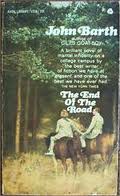
THE END OF THE ROAD


The End of the Road, John Barth, Doubleday & Company, 1958, 188 pp


Barth wrote this second novel as a companion to his first, The Floating Opera. Again he investigates marriage and infidelity, but while in The Floating Opera almost all was felicitous, The End of the Road is dark and rests on catastrophe.

Jacob Horner, the main character and narrator, could be straight from a Patricia Highsmith story. Amoral, self-centered and borderline psychopathic, he is under treatment by an eccentric and experimental psychiatrist, probably unlicensed, who is mainly interested in testing his offbeat theories.

Under doctor's orders, Jacob, who is suffering from "immobility," takes a teaching position at a State Teachers College and soon enters into a relationship with a colleague's wife. Thereby ensues a downward spiral in which the wife and husband are inexorably sucked into Jacob's toxic troubles.

Entertaining, disturbing, humorous at times, and fascinating in a compulsive, can't-stop-looking way, the book made me feel I was in the clutches of a frightening intelligence. Next for this author is the somewhat infamous Sot-Weed Factor. Oh my.


(The End of the Road is available in paperback which also includes The Floating Opera by order from Once Upon A Time Bookstore.)


Monday, May 30, 2011

THE TEN YEAR NAP


The Ten Year Nap, Meg Wolitzer, Riverhead Books, 2008, 351 pp


Note: For an unknown reason, I am still not able to upload any images to my blog. It doesn't look as cool without the book cover, but at least I can post my review. Bear with Blogger and stick with me. The last time this happened, it eventually got sorted out.

In The Ten Year Nap, Meg Wolitzer takes on the "mommy wars." The whole issue of stay-at-home moms versus working moms has reached new heights this year but in 2008 was a hot new debate. Is the stay-at-home mom a better mother than the one who manages to continue her career? What is better for the kids? Which mother type is more fulfilled? How does a woman who left the work force to raise children get back into working? 

 As has often been mentioned, these questions are actually the luxury of a privileged minority of middle-class women who do not need to work for economic reasons or women who, together with their husbands, have enough income to afford help with child rearing and housekeeping. The majority of women in the world either have to work just to keep their children fed and sheltered or live in societies where women are not permitted to work outside the home.

 This novel is peopled with women who are dealing with the various scenarios of the middle-class mom. Wolitzer covers the dominant issues and the usual ways in which such women interact in a 21st century urban setting. Just for balance, one of the characters is a working mom.

 The main trouble I had with the book is that it reads more like an enhanced thesis: lots of facts with case histories included. The characters come across more as types than as living, breathing individual women. The thin plot is concerned with how each woman copes with turning forty and gradually waking up from the "ten year nap" of raising children only to realize that she is bored. Wolitzer indulges in far too much telling rather than showing.

 I suppose if a reader had no other female friends with which to discuss such troubles, she could find some solace or even help by reading The Ten Year Nap. I felt the author took on a relevant and timely issue and somehow made it dull. If you are a working mom by necessity, you might not even have time to read novels, but if you do, this one will either make you laugh or tick you off.


(The Ten Year Nap is available in paperback by order from Once Upon A Time Bookstore.)

Tuesday, May 24, 2011

THE DHARMA BUMS


The Dharma Bums, Jack Kerouac, The Viking Press, 1958, 244 pp


(Sorry, no image today. Blogger won't cooperate.)


  I first read The Dharma Bums in about 1969. It was our instructional manual on "how to be a hippie." The long, late-night drug and alcohol fueled parties, the disdain for money and suburbia and middle class life, the simple foods and hanging out on the floor. Hiking in the woods, free love, earth mothers and footloose uncommitted men. 

As soon as my first husband and I reached San Francisco after driving and camping our way across America from Michigan, we climbed up to Mount Tamalpais and got high with all the hippies and their naked children in a mountain meadow. The only thing we didn't do is ride the rails, but we did sometimes hitchhike and we always picked up hitchhikers.

 All these scenarios and more fill the pages of The Dharma Bums in Jack Kerouac's breathless prose. He is searching through Buddihism, poetry, and friendship for a life that makes sense. Kerouac's life was brief. At that breakneck pace and that level of alcohol use, he was bound to burn out young.

 But along with a very few others, right smack in the middle of the 20th century, he created a sensibility which has infected spiritual seekers, writers, musicians and artists right up to the present. Not a man to marry, not a man to depend on in any way, Jack Kerouac had another mission on this earth and I thank him to this day for capturing both the incipient sadness and the rarely achieved joy of life.


(The Dharma Bums is available in paperback by order from Once Upon A Time Bookstore.)

Wednesday, May 18, 2011

THE POSITION


The Position, Meg Wolitzer, Scribner, 2005, 307 pp


 Though this is her seventh novel, it is the first I have read by Meg Wolitzer. She is about ten years younger than me, so not the next generation but somewhere in between. The Position is marketed as humorous. I found it to be an attempt at irony but ultimately a sad story.

  Paul and Roz Mellow, very much in love, deeply passionate, and in the process of raising four children, conceive of an idea. The result is a book called Pleasuring: One Couple's Journey to Fulfillment, complete with artist renderings of the couple having sex in a cornucopia of Tantric positions. They also invented a position of their own, recommended to couples who have just had a fight.

 So imagine you are somewhere between six and fifteen, it is the seventies and your parents are in a bestselling book having sex; they are giving talks, appearing on TV, and have somewhat left you and your three siblings on your own. You all sit down together and look at the book.

 Right. So this novel is the story of how their book affected the kids and what it did to the Mellows' marriage.

 I am not quite sure I buy it but then I was one of those crazy sexual revolution type parents, as was my first husband. We were very open about sex, about our marriage and about all the other excesses of the decade. We got divorced when our sons were in grade school. Said sons are now happily married, heterosexual, have children and fulfilling jobs. They don't seem to have suffered more than I did growing up, just differently. But what do I know?

 The novel is entertaining. Meg Wolitzer doesn't glamorize her characters or come on as an alarmist. Her perceptiveness about women, men and children is her best quality, along with a certain humanist urge to find the best in people. We all spend our lives getting over our parents and The Position is one version of that tale.

 I plan to read another Wolitzer novel, The Ten Year Nap, and then her latest which I will be reviewing "professionally." If I sound tentative it is because I am undecided about the author. If I got to sit with Meg and a bottle of wine, I have a feeling we would find many viewpoints in common. It is just that I like women novelists who write about the female experience to be better writers. Margaret Atwood is my gold standard and I have a list of others. I am not ready to add Meg Wolitzer to that list.


Tuesday, May 17, 2011

BREAKFAST AT TIFFANY'S


Breakfast at Tiffany's, Truman Capote, Random House Inc, 1958, 111 pp


 One of the coolest aspects of My Big Fat Reading Project is finally reading so many books I've always heard about, maybe even planned to read "someday" but have not gotten to. If not for the project, I might have never read them at all. 

 Such is the way it was with Breakfast at Tiffanny's. Years ago I saw the movie and was an Audrey Hepburn fan ever after. Then there was the 1995 song by that title, performed by one-hit wonders Deep Blue Something. The horrendous wonder of the modern world is that pop cultural references can give the illusion that you know something when in reality you only know the most insignificant facts about it. 

 This novella could not have been written by anyone but Truman Capote. Who else could have created Holly Golightly and her tragicomic past? As I read through my list of books from 1958, I recognized her as truly a representative character from the time period. She is a composite of Auntie Mame, Styron's Sophie and a Carson McCullers heroine; damaged but unsinkable with a dream of happiness (eating breakfast at Tiffany's) without illusions about its transitory nature.

 I also watched the movie again, which has that sappy happy ending with the kitten. Even so, I will never be able to picture Holly Golightly without seeing Audrey Hepburn. I think Capote would be OK with that.


(Breakfast at Tiffany's is available in paperback by order from Once Upon A Time Bookstore.)

Friday, May 13, 2011

THE BELOVED DEAD


The Beloved Dead, Tony Hays, Forge Books, 2011, 400 pp


 I am always intrigued by any version of the King Arthur tale. The Beloved Dead is the third in the Arthurian Mysteries series by Tony Hays. Each volume entwines King Arthur's life and ascension to High King with a murder mystery. Of course a murder needs a detective and sure enough Arthur had his own private investigator, Malgwyn, who was also his most trusted adviser.

  Also true to murder mystery form, Malgwyn had personal troubles: deep grief over the slaughter of his beloved wife by Saxons and a weakness for alcohol. Because Arthur saved the man's life, though not his right arm, Malgwyn pulled himself out of a suicidal depression to assist this King for whom he had a deep love.

 I have not read the two earlier volumes in the series, The Killing Way and The Divine Sacrifice, but this volume has convinced me to do so. In The Beloved Dead, Malgwyn is up against a serial killer who violates and mutilates the bodies of maidens as part of the murders. Truly gruesome descriptions of the murderer's signature mutilation not to mention continuous scenes of mayhem bring to life the brutal level of violence that characterized daily life in fifth century Britain.

 I liked the way Hays made use of the political situation to anchor his story. Ever since the Romans had pulled out of Britain because of the barbarian invasions into Rome, Britannia lost their civilizing force, devolving into internal battles between various tribal lords. Arthur rose to power because of his ability to unite these tribes against their common enemy, the Saxons. It was however an uneasy alliance.

 As The Beloved Dead opens, Arthur has recently been crowned the Rigotamos, High King of all Britannia. Due to religious conflicts between traditional Druids and followers of "the Christ" in addition to rivalries always ready to erupt, Arthur has decided to deliver a blow to Druid superstition while at the same time entering into a politically strengthening marriage. Ever the idealist who cared deeply for the "people" and dreamed of peace for his land, Arthur is also portrayed as somewhat pig-headed and impetuous when it comes to political moves. The murders began immediately following Arthur's announcement of his marriage and his perceived desecration of a Druid burial ground.

 At first I was put off by Tony Hays' writing style which eschews elegance for a down-to-earth tone. He is compelled to repeat himself every fifty pages or so, hammering in his themes about male/female relations and the mentality of a serial killer. But in the end I was impressed by the strength of his story and the historical depth he brings to the Arthurian legends.

 After all, for those of us compelled to read any story we can get our hands on when it comes to Arthur, Guinevere, Merlin and the rest, comparing the myriad tellings of the tale is at least half the fun.


(The Beloved Dead is available in hardcover by order from Once Upon A Time Bookstore.)

Thursday, May 12, 2011

THE BEST OF EVERYTHING


The Best of Everything, Rona Jaffe, Simon & Schuster, 1958, 437 pp


 Here is another novel from the 1950s telling us that lots more sex went on than we were led to believe and that what women really want is love and a husband. It is a mildly entertaining story. Set in the office of a publishing company and following the lives of four young women, it has been called the Sex and the City of the 50s. 

 Rona Jaffe wrote the novel, her first, when she was 24, a recent graduate of Radcliffe, working as an associate editor at Fawcett Publications. The writing is just fine. Her portrayal of young women working at a publishing company comes across as realistic and includes a lecherous, alcoholic chief editor; a female associate editor who resembles that terror in The Devil Wears Prada; and the typing pool of women where all the drama plays out.

 Sadly, not that much has changed for women in the past sixty years except that more is out in the open. Judging from the current fiction I read (I don't watch TV), American women still want love, marriage, a house to decorate and supervise, and children if they can get pregnant. Some women also want a career, a professional life, personal fulfillment outside the family.

 The facts are that most people need to work for a living and that men usually must have a job but often don't find personal fulfillment in their work, another subject often addressed in 1950s fiction. Still, we all love our dreams, our hopes, and we read the books that allow us to step outside the humdrum of "real life." Some of the books are especially for women, some are for men and some satisfy both. The Best of Everything is clearly a woman's book and if I had read it in my twenties I would have been fascinated.

 The above paragraph, while not profound, was my conclusion after finishing the book. Out of the four women, two achieve a semblance of the dream but all are damaged to a degree by their efforts to get there. The problem with this sort of fiction is that it all boils down to a common denominator, which I suppose has much to do with its popularity. Are we just inherently shallow? 

 There were no true heroes or heroines in Rona Jaffe's book. She went on to write romantic fiction for years, having several bestsellers. I hope she had fun. Oh yes, and there was also a movie. Has anyone seen it?


(The Best of Everything is available in paperback by order from Once Upon A Time Bookstore.)

Wednesday, May 11, 2011

THE LACE READER


The Lace Reader, Brunonia Barry, William Morrow, 2008, 385 pp


 The Lace Reader took me completely by surprise. The covers of both the hardcover and the paperback gave me the impression of some romantic, atmospheric story. The title had me expecting a quirky little tale about either elderly or New Age-type women sitting around drinking tea and predicting the future.

 Aunt Eva is the only elderly lady and she is missing, so never actually appears as a character except in others' recollections. Towner Whitney is her troubled great-niece. By troubled I mean seriously mentally ill, on medication, seeing visions. As the story opens we learn that she suffers from a teenage trauma involving a twin. After twenty years of self-exile in southern California, Towner comes home to Salem, MA.

 Salem, MA? Witches? Yep, witches, ancient and modern. Also Towner has a difficult relationship with her mother, an agoraphobic who lives on an island and rescues abused women.

 All of this is revealed gradually by Towner herself. She is the unreliable narrator of all time but also funny in an ironic, Job-like way. After about 40 pages, I was drowning in quirkiness but had the feeling there was more going on if only the author would get to it.

 Well. Turns out there was plenty more and much of it is mighty disturbing: abuse of both children and women, addiction, mental illness and more. Some of the Whitney women can indeed read the future in lace patterns but like most people who have "the sight" the future is mostly not pretty.

 The Lace Reader can be hard to follow and the end is confounding, leaving the reader with as many questions as answers. However, it is a great read in the tradition of Daphne du Maurier. You are put into the upset mind of Towner and come close to feeling crazy yourself. I thought that was some canny writing and also realistic: she is not crazy all the time; it's intermittent. The brilliance of embedding a mystery in an unbalanced mind reminded me of Patricia Highsmith.

 Oh so tastefully, without preaching or moralizing, Barry gives us the murky world of abused women. No easy answers but this one: abused women are best helped by women. Some readers get upset when animals get hurt in novels. For me that is nothing compared to abuse of females. By the end of The Lace Reader, I had been shamed into realizing that I had still harbored some idea that abused women basically ask for it. I will NEVER feel that way again.

 This novel is powerful like the ocean on the cover and somehow also as gentle as the lace.


(The Lace Reader is available in paperback by order from Once Upon A Time Bookstore.)