Tuesday, May 03, 2011

THE BELL


The Bell, Iris Murdoch, The Viking Press, 1958, 342 pp


 Iris Murdoch's fourth novel shows a strengthening of fictional power while continuing her philosophical inspection of human character. I love the opening lines: "Dora Greenfield left her husband because she was afraid of him. She decided six months later to return to him for the same reason."

 Dora is one of the two main characters and represents the amoral personality. She is a fairly young woman, married to an older man. While living mainly on nerves and feelings, she has a horror of any sort of confinement and is allergic to boredom, but has virtually no concept of right and wrong. 

 The other is Michael Mead, a failed religious man who struggles with his homosexuality like a character from Graham Greene. Because sodomy is considered a sin in Christianity, Michael's deep desire to be a priest is constantly thwarted by his failure to keep his sexual desires in check.

 The setting is Worcestershire, England at Michael's family estate, where he has created a small lay community of Episcopalians who seek retreat from the world as they attempt to deepen and live out their Christian faith. Dora provides the comedy, which is always a flavor in Murdoch's books. Michael brings the anguish. The other characters are there to create the interactions, tensions and plot, but none are flat or feel secondary.

 I admired Murdoch's talent in examining such weighty ideas without judgement. If she found any of her characters unworthy, she only made it known with her tongue in her cheek. Also impressive was her range of personalities, both male and female. Besides the flighty Dora are a hardworking mother-hen type, a fairly psychotic young woman who intends to become a nun, and a deeply wise Mother Superior in the nearby convent.

 The eponymous bell stands for an ancient portentous legend and an object of desire, while it drives the plot. I was not wild about the long descriptive passages but did not mind the somewhat lengthy expositions on Michael's and Dora's inner lives. For some reason known only to Iris Murdoch, she used the word rebarbative about every thirty pages. A joke?

 Finally, it was historically fascinating to compare the mid 20th century views on male homosexuality to those of the early 21st century. Murdoch gives a clear picture of the previous mindset but was undoubtedly ahead of her time.

 The more Murdoch I read, the more impressed I am. I saw a comment by some reviewer the other day stating that Murdoch tells the same story over and over. I couldn't disagree more. She has that theme of human personality and interaction, but each novel I have read so far is unique.


(The Bell is available in paperback by order from Once Upon A Time Bookstore.)

Monday, May 02, 2011

BALTHAZAR


Balthazar, Lawrence Durrell, E P Dutton & Co, 1958, 250 pp


 This is the second volume of Lawrence Durrell's "Alexandria Quartet." He calls it not a sequel to Justine but a sibling. Balthazar was the mystic philosopher in Justine who brought many of the characters together in regular meetings for study of the Cabal and other writings. 

 In this version of the story, most of which is a letter from Balthazar to the writer of both novels, new light is shed on the relationships between the characters. I found it more readable and engaging than Justine. Durrell still waxes poetic on the beauties, mysteries and dark sides of Alexandria, but situations which were enigmatic in the first novel now become more clear. The tale takes on a flavor of intrigue, both political and personal. The reader begins to understand that there was quite a bit more going on than a simple love affair between the author and Justine.

 Durrell himself has a grand intellectual and artistic scheme at work in the quartet which, in these days of novels as commodities, seems almost too precious. Reading him now is a look into past literary pursuits and made me see how much things have changed; even made me a bit nostalgic. But, as Durrell asserts, time is relative and there is no going back. There is only the continuum.


(Balthazar is available in paperback by order from Once Upon A Time Bookstore.)

Thursday, April 28, 2011

EMILY ALONE


Emily Alone, Stewart O'Nan, Viking, 2011, 255 pp


 After finishing Wish You Were Here, I went immediately into Emily Alone, the sequel. I was already intimately involved with this family and though Wish You Were Here was far from an ideal novel, it was worth having read it because I could more exactly track with Emily as she lives through a winter and spring in her Pittsburgh home. 

 In this novel, approximately eight years have passed since Emily's beloved husband Henry died of cancer. She lives alone with Rufus, her aging springer spaniel, surrounded by her furniture, paintings, china and silver, listening to classical music, reading novels and suffering from loneliness and the indignities of her own aging. She is the oldest remaining woman in her neighborhood, her best friend having died a year ago. Attending funerals is now a constant in her life.

 Emily's closest companion is her sister-in-law Arlene, who lives nearby. Once a week they have breakfast together at Eat'n'Park's two-for-one breakfast buffet. Emily clips the coupon from the Sunday "Post-Gazette." Arlene drives, badly, which makes Emily highly nervous though she knows she should feel grateful. 

 If Stewart O'Nan didn't write so close to the bone, these two women and their mishaps would be comedic. Somehow Jonathan Franzen makes this sort of thing funny, but that is not O'Nan's way.

 Over the past decade I watched my father succumb to Alzheimer's, finally going into a home where he died at the age of 87. Then I watched my mother grieve, age and go on to live alone for five more years until a series of strokes finally ended her life. Reading about Emily battling with loneliness and a deteriorating body while being continually disappointed by her son and daughter, yet living for Thanksgiving, Christmas and a week in the summer at Lake Chautauqua, when she can be together with them and her grandchildren, I felt I was going through it all over again. It was almost too much for me. 

 If you have watched a parent or grandparent move through this period of life that our society calls "The Golden Years" or if you are going through it yourself, I advise you approach Emily Alone with extreme caution. I was talking to my sister about it all and we both decided that, should we find ourselves outliving our husbands, we certainly will not live alone. 

 I used to want to live to be 100 and become wise. It might be wiser to quit while I am ahead. Maybe I will take up a dangerous sport. I don't enjoy sports though. Possibly race car driving. I like driving, a lot. Emily liked driving also. She finally traded in her old gas hog for an all-wheel drive Subaru wagon, as did my mom. 

 Did I find this book depressing? Oh, just a little.


(Emily Alone is available in hardcover by order from Once Upon A Time Bookstore. Wish You Were Here is available in paperback.)

Tuesday, April 26, 2011

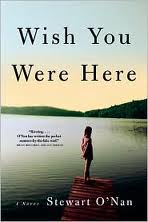
WISH YOU WERE HERE


Wish You Were Here, Stewart O'Nan, Grove Press, 2002, 517 pp


 Have you ever spent a week in the summer with extended family? As a child it is non-stop fun with cousins and outdoor activities. As a teenager it is mostly a crushing bore. As adults, it is more work than vacation: the meals, the clean up, the excursions, sharing bathrooms and bedrooms. As grandparents, possibly you look forward to it all year, but when the week comes you are quickly exhausted by all the random activity of having so many people in such close quarters.

  The scenario of Wish You Were Here includes all of the above. Grandmother Emily, who lost her husband to cancer some months ago; Margaret, the black-sheep recovering alcoholic daughter who is about to be divorced with her teenage girl and eleven-year-old son. Kenneth is the nice but dreamy son who just quit his job to pursue being a photographer, with wife Lisa, teen girl and eleven-year-old son. In addition is spinster Aunt Arlene, sister of Emily's dead husband. They are all crammed into the family summer cabin on Lake Chautauqua in New York State. It will be their last time there before the cabin is sold.

 Stewart O'Nan is a realist writer. Every object, meal, mood, activity and surrounding area is enumerated in exquisite detail, like an early French slice-of-life novel. In 517 pages, seven days are covered from waking to bedtime. The pace is about the same as what I remember from teenage visits to my grandparents. And of course, there are constant issues. Should we drink around Margaret? Kenneth's wife is rather an insecure, spoiled brat who is jealous of her husband's closeness with his family and annoyed constantly by Emily. It goes on and on.

 As I was doggedly plowing along through those seven days and going slowly crazy, I wondered if any of the thousands of tense scenes would ever explode into some action or tragedy or release (they don't). It suddenly struck me. The author has exactly created what such a week is like from each viewpoint: grandmother, adult children, daughter-in-law, teen girl, young boy. Emily talks just the way my mother did and has similar quirks. The high maintenance daughter-in-law could have been me in my younger married years. 

 Honestly it was as if O'Nan held up a mirror to my extended families, of which I have had three, since I divorced and remarried. As I read, I felt exposed, self-conscious, sometimes ashamed and once in a while amused. 

 I don't know that it did me any good to read this novel. I made it to the end as did Emily's family make it through the week, relieved to know I could go back to my usual life. I guess that was the point. We all have families, we are all self-involved and petty. Along with the fun of such gatherings is a somehow equal level of annoyance. I may never attend another family reunion but if I do, I am not sure if I will laugh or cry. I will certainly know that my family is not that much different from anyone else's and that we are all just a little bit crazy.

Thursday, April 21, 2011

WHY YOU HAVEN'T HEARD FROM ME


MOVING DAY BECAME MOVING WEEK, AND BEYOND


Dear Readers,
I have been absent from the blog for almost three weeks. I thank all of you who have continued to visit. I have a really good excuse though. 

On March 28, my son, his wife and three children moved from Florida to Los Angeles. They joined myself and my husband in our two bedroom house for nine days while they waited for their moving van to arrive. 

Meanwhile, my husband and I closed on the purchase of a house on March 31 and I began packing up our stuff while hubby worked an unusually heavy schedule of double shifts. He is a free-lance guy, so when there is work, he works. After three days of haggling and other problems, the former owners finally got all of their stuff out of our new house. Then the real work began.

Honestly, it was the filthiest dwelling I have ever moved into. So at first all I could do was clean the new house half the day, pack the old house the other half, then fix dinner for our extended family. Oh yes, and with 7 people to feed everyday we kept running out of food, so somewhere in there I would run to the store for more. While my son and daughter finalized the renting of their apartment, bought a car, etc, I watched the grandkids. That was actually the best part, because I am so happy to have them around.

Finally on April 12, our own moving van came, loaded up our furniture, my 30 boxes of books, and all the other stuff and moved it the mere four miles away. That of course took all day and they managed to put little nicks in almost every piece of furniture, but at least everything was pretty much in the right room. The next day, my daughter-in-law, who is a top notch cleaner, helped me clean the old house while hubby and son finished moving the inevitable final truck loads of odds and ends. 

So Wednesday, April 13, I got up from my bed in the new house and started unpacking. That process continues but I am down to the last boxes. Still cleaning, inside and out but the end is in sight. Yesterday, I got my "desk" out of the two banker boxes and began to get a grip on what used to be my real life. And here I am.

We have a fabulous house in a nice tree-filled neighborhood at the top of a hill. That sounds luxurious and in a sense it is, but really it is just a good house in a cool spot that does not feel like LA. In fact, it is just on the verge of being rural. Once I get over my exhaustion, it is going to be an ideal place to do what I love best: read, write, cook and grow flowers. 

And one day I will write the tale of the move because it was full of hilarious, horrendous and unbelievable moments, just like a novel.

Tomorrow I will be back with a book review. Thanks again for sticking with me. 

Do you have a good moving tale?


Sunday, April 03, 2011

THE SUNDAY FAMILY READ


This week for the Sunday Family Read I present two guest bloggers who happen to be my lovely granddaughters Jordan (age 12) and Emma (age 9)


Prom & Prejudice, Elizabeth Eulberg, Scholastic Inc, 2011, 227 pp


 I liked this book because the author is truly funny and she uses lots of detail which is very good in this story.

 I also liked it because there is teenage drama, teenage love, danger, comedy, and embarrassment.

 I suggest you read this book. I am now reading her earlier book, The Lonely Hearts Club.

 Jordan Elizabeth


Fantastic Mr Fox, Roald Dahl, Puffin, 2007, 96 pp


 I really like this book. I also like the author. Roald Dahl has lots of books and I am very familiar with the illustrations. 

  Many of his books have now been turned into movies. My family loves the movie made from Fantastic Mr Fox, especially when they use the word "cuss" instead of any swear words. Now we do that too, so we don't get in trouble. 

 I plan on reading more of his books and I hope you do too!!

 Emma Jean


(Both of these books are available at Once Upon A Time Bookstore.)
 

Wednesday, March 30, 2011

THE BIG TIME


The Big Time, Fritz Leiber, Ace Books, 1958, 130 pp


 As a reader I cannot see why this won the 1958 Hugo Award, but his fellow science fiction writers of the time thought it was a big deal. The basic premise of the story is time travel. The "Big Time" refers to a time continuum outside of time where soldiers of the Change War battle in attempts to change the future by going back in time and altering history.

  So I get that this is a cool idea. I have also noticed that Heinlein, Asimov and others were writing time travel stories in the 1950s. But the storytelling is lame, without much going on. The characters are distinctly odd and the spare dialogue hard to follow. 

 Greta Forzane is a self-proclaimed party girl who narrates and attempts a bit of philosophizing. She "works" in The Place, where weary warriors come to chill out, drink, have sex and get medical attention as needed. It is presented as a sort of nightclub in space with a bar, comfort girls, a drunken doctor and couches for resting.

 So I read it because it was a Hugo winner on my list. Took me a few days to get through the 130 pages because it was boring. The writing was like listening to some nerd talking to you non-stop about minor political activities. I could barely bring myself to pay attention. A definite miss in the history of the Hugo Awards.

 If you are a sci fi specialist and think this book is a must-be-read classic, would you please leave a comment and explain why?


(The Big Time is available in paperback by order from Once Upon A Time Bookstore.)

Monday, March 28, 2011

A PRAYER FOR THE DYING


A Prayer for the Dying, Stewart O'Nan, Henry Holt and Company, 1999, 195 pp


 I am catching up on some Stewart O'Nan fiction in preparation for reviewing his newest novel. Many years ago I read his first novel, Snow Angels, and was fairly creeped out by how dark it was. Creeped out in a good way because I like dark stories. Apparently O'Nan had further darkness to explore. A Prayer for the Dying is his fifth novel and is so short that it could be called a novella. But it is so packed full of emotion, events, and psychological turmoil that it works as a full length novel with all unnecessary fat trimmed away.

  Jacob Hansen is a Civil War survivor, now back home in Friendship, Wisconsin. He is married to his true love and they have recently had a child. Because Friendship is such a small town, Jacob is the sheriff, the undertaker as well as the pastor of a Protestant church. Each of these jobs become important and burdensome because overnight, Friendship is invaded by diphtheria, an enemy that kills more thoroughly and rapidly than any war ever could.

 When Jacob was slowly starving to death in the depths of the war, he made a bargain with God: to be an upright man and serve Him if he survived. Well, he survived though his wounds were mostly emotional and mental. Now as he goes about his duties, burying corpses, trying to protect his wife and child, and enforcing a quarantine, he learns the true nature of the bargain he made. More dramatically he comes to know his own true nature.

 O'Nan raises the bar on dark psychological fiction by writing the entire novel in the second person, present tense, injecting the reader into Jacob's mind and heart. As the disease progresses inexorably through the town he becomes a bit more unhinged, hour by hour, day by day, desperately trying to do what is right while mostly everything is going wrong.

 Movies are good. I saw the movie made from Snow Angels and it was effective. But O'Nan's writing is hundreds of times more effective as he shows you the dark, nasty insides of men's minds; the crippling, emotional cost of dealing with life's hardships; and the power of love to light the darkness but also to kill all hope when it is lost.

 This author get heaps of praise from other writers and rightly so. I doubt that his books are strong sellers. He writes about what we all experience in our deepest most private moments but do our best to hide from ourselves and others.


(A Prayer for the Dying is available in paperback by order from Once Upon A Time Bookstore.)

Sunday, March 27, 2011

TIME OF WONDER


Time of Wonder, Robert McCloskey, Viking Press, 1957, 63 pp

The Sunday Family Read


 Robert McCloskey won the Caldecott Award for this lovely portrayal in words and illustrations, of a family's summer in Maine. His most famous and beloved book was Make Way For Ducklings, which was set in Boston and won the Caldecott in 1942. He also wrote Blueberries for Sal which I remember from childhood. It made me want to go berry picking.

 I loved how the two sisters in Time of Wonder would go out by themselves in row boats and sail boats. Each illustration shows everything mentioned in the text. I read this just a few weeks after reading Olive Kitteridge and the two books together made me passionately interested in visiting Maine. It is one of the few states I have never visited. That is the power of books!


(All of the Robert McCloskey books mentioned in this review are available on the picture books shelves at Once Upon A Time Bookstore.)

Friday, March 25, 2011

ROOM TO SWING


Room to Swing, Ed Lacy, Harper, 1957, 177 pp


 As part of My Big Fat Reading Project, I read the major award winning books from each year. The Edgar Award for mystery writing began in 1954. Aside from Raymond Chandler in 1955, none of the winning authors have stood the test of time. I had not heard of Ed Lacy before though he had a good reputation in the 1950s and has recently been brought back into reprint.

  Ed Lacy is a pseudonym for crime writer Leonard Zinberg, a New Yorker, professional writer, political leftist and all around character. His lifelong interest in African American culture and leftist politics stemmed from his Jewish upbringing in 1920s Manhattan, on the fringes of Harlem. His wife was African American and many of his early stories concerned racial injustice.

 In 1951, Zinberg published his first mystery as Ed Lacy, but it was Room to Swing with the first credible African American PI which brought him critical praise and the Edgar Award in 1958. 

 Touissant "Touie" Marcus Moore is living on the edge in a small apartment in Harlem, which doubles as his office, trying to make it as a private investigator. On a day when his funds are particularly low, he is lured into a TV promotional operation by a hot redhead who considers herself "sympathetic" to Negroes. Next thing he knows, Marcus is a murder suspect and must find the actual murderer in order to save himself.

 He follows the trail of evidence to a small southern Ohio town. Lacy gets the Jim Crow elements of 1950s Ohio just right while he throws in some excellent Raymond Chandler style metaphors. A nice little love story develops in Ohio and bubbles beneath the surface of a fine mystery with some unusual quirks.


(Room to Swing is available in a nice paperback reprint by order from Once Upon A Time Bookstore.)
Wednesday, March 23, 2011

QUIET AS THEY COME


Quiet As They Come, Angie Chau, Ig Publishing, 2010, 195 pp


  Angie Chau is a Vietnamese woman who emigrated to the United States as a child. Her collection of stories is based on that experience and on her coming of age in a Vietnamese immigrant community in San Francisco.

  The writing is incredibly good. I have read a number of books, fiction and memoir, about Asian immigrants growing up in America and this one is right up there with those by such writers as Amy Tan and Lisa See. Ms Chau captures the confusion, the sense of being lost between two cultures and the effects of this on both the parents and the children.

 The most heartbreaking story was about Kim, who renamed her two children Sophia and Marcel, after her favorite movie stars. She is waiting and longing for the husband she had to leave behind because he had been captured by the Vietcong and imprisoned. When he is finally released and makes it to San Francisco, he is so traumatized that he finds it impossible to reunite with his family.

 In another story, a mother treats her sick daughter with traditional remedies, one of which leaves bruises on the girl's spine. Soon after, a worker from Social Services arrives at their home to make sure the girl is not being abused. The poor mother, who did in fact cure her daughter, is deeply embarrassed by the social worker.

 I loved this book and will from now on look at any Vietnamese person I meet with increased respect.


(Quiet As They Come is available in paperback by order from Once Upon A Time Bookstore.)

Tuesday, March 22, 2011

THE WAPSHOT CHRONICLE


The Wapshot Chronicle, John Cheever, Harper & Row Publishers, 1957, 307 pp


 John Cheever is best known for his short stories, but his first novel won the National Book Award in 1958. I was expecting one of those John O'Hara or John Marquand novels because I had gotten the idea Cheever was a "New Yorker" favorite. Instead, I was pleasantly surprised.

  The Wapshot family has lived for generations in a New England village which began as a sailing port. By the time of the novel, it is a dying town and the fading family lives mostly for tradition. Leander Wapshot, the current head of the family, likes to fish and take out the SS Topaze, a decrepit old launch, picking up passengers from the train in the next small town and ferrying them across the bay to an amusement park. He also keeps up the family chronicle started by a forebear generations earlier. 

 The money which is left in the family belongs to Leander's sister, a spinster who is even more eccentric that he is. Leander's two sons realize as they come of age, that Aunt Honora will only leave the money to them if they make something of themselves and produce sons. Since there are no prospects for either requirement in the small town, they set off into the world to seek careers and women.

 Because of Cheever's incredibly fluid style, his sense of humor and his unique characters, The Wapshot Chronicle is a great read. In fact, it stands out as the best NBA winner since the award began in 1950. (That is my opinion, but I have read them all.) He has captured the essence of that area of New England just north of New York City which is now filled with bedroom communities for people with families who work in the city. The Wapshots are right on the cusp of the changing fortunes of that area and Cheever presents them without sentimentality or heaviness but with heart, honoring a bygone era and type of people as they make their stumbling transition into the 20th century.


(The Wapshot Chronicle is available in paperback by order from Once Upon A Time Bookstore.)

Monday, March 21, 2011

THE WORLD BENEATH


The World Beneath, Cate Kennedy, Grove/Atlantic, 2011, 342 pp


Australian novelists rock. A certain grittiness combined with tenderness and an honest look at the helplessly dysfunctional nature of the human heart show up in authors from down under such as Tim Winton, Evie Wyld and others I have read. Cate Kennedy is firmly in that class with her first novel.

The story in The World Beneath revolves around a fractured family, an out-of date subculture and an extinct Tasmanian species. Rich and Sandy, two idealistic young people, fell in love during the 1980s as they fought side by side to save the Franklin River in Tasmania from a dam that would have disrupted the ecological balance of the island’s vast wilderness. So young, so unformed, so clueless about life in many ways, they formed a bond that lasted ten years based purely on the shared exhilaration of that moment in time when it seemed their idealism had the power to change the world. When a child entered the picture, Rich came flat up against his interpersonal shortcomings and ran for his life, leaving Sandy to bear the consequences. 

We have all known a Sandy in some form. She holds desperately to a New Age outlook, making do with little to no financial security, living as much as possible off the grid in a small town, bolstered by women friends of similar persuasions. Her devotion to raising her daughter Sophie justifies everything in her mind. The fact is, she bears such a deep grudge against Rich and his desertion that she has never really moved on. Sophie is now about to turn 15. She is the one who keeps it together for her mom, and longs to know this father she has never met. Rich has recently reconnected with Sophie and now is her chance.

By the time Rich and Sophie set off for a week long hike on Tasmanian trails, the reader knows enough about all three characters to suspect that extreme danger lies dead ahead. The slow build of suspense, the revealed personality fractures in these characters, and the threatening weather of Tasmania work to suck the reader right into the vortex along with Rich, Sophie and Sandy.

Sophie is the lynchpin and in the end the true hero of the story. Pierced, buried under Goth-style clothes and hair, frighteningly intelligent and competent but wound up almost to the point of annihilation, she lights up this tale with intensity. Her teenaged irony and contempt for anything adult is perfectly created in the dialogue and is one bright spot of humor in a fairly dark tale. Although when Sandy goes off for her yoga retreat while Rich and Sophie are on walk about, the New Age instructors and counselors get their fair share of mockery. Even Sandy can laugh at herself sometimes when she isn’t freaking out.

All in all, this is a great and gripping read, from the first sentence to the last. One review I read mentioned lengthy stream-of-consciousness paragraphs; another looked for more profundity. In fact, the writing is precise and assured, which is what you would expect from an author who has been called Australia’s Queen of the Short Story. It has been a while since I have read a more profound look at the gap between generations and the demands of parenthood. When the Tasmanian tiger shows up at the most tense moment of the whole wilderness adventure, I knew I had been taken even deeper than I realized and that either complete disaster or some form of redemption was at hand.


(The World Beneath was published in Australia in 2009 but is now available in paperback in the United States. You can request at copy at Once Upon A Time Bookstore.)

Sunday, March 20, 2011

ELOISE AT CHRISTMASTIME


Eloise at Christmastime, Kay Thompson, Simon & Schuster, 1958, 45 pp

The Sunday Family Read 

 I have been putting off posting this review since it is so not Christmastime. But today we are having what is probably the last winter storm of the rainy season in southern California and it is Sunday Family Read day here at Keep the Wisdom, so we will look at my opinion of this holiday book.

 Ah, the American way. Ah, the book business. For the third year in a row, Kay Thompson made the top ten bestseller list with an Eloise book, coming in at #6 in 1958. Her first two Eloise books,  Eloise and Eloise in Paris,  made me use timeworn but truthful adjectives such as charming and delightful, but this time I can only say negative words like commercialism and enough already. Since she did not make the top ten again despite publishing Eloise in Moscow in 1959, perhaps Ms Thompson should have quit while she was ahead.

 In Christmastime, Eloise becomes nothing more than a most annoyingly hyperactive child. The charm and humor of the earlier books is lost in a manic flurry of Christmas cliche. Hilary Knight's drawings are still wonderful and Eloise's Christmas gift list almost saves it, but I finished the book feeling like someone had brought their ill-mannered, out of control child to my house and stayed too long.


(All of the Eloise books are available in the picture book section at Once Upon A Time Bookstore except for this one which is usually in stock only in December.)

Friday, March 18, 2011

VICTORINE


Victorine, Frances Parkinson Keyes, Julian Messner Inc, 1958, 380 pp


 I thought I was done with Frances Parkinson Keyes bestsellers after completing my 1957 reading list, but it turns out there was one more to go. She went on writing novels until 1970 but Victorine, at #10 in 1958, was her final bestseller. She is not too bad but not good enough to add to my list of authors to follow.

  Victorine is a sequel to Blue Camellia from 1957, which was one of her better novels and is set in Louisiana during the time when rice was first developed as a crop there. In that novel Lavinia, the heroine, had two children who in Victorine are grown and ready to get married. Prosper, the son, falls in love with Victorine, an impossibly perfect woman. But Proper's fling with a Creole dancer at the local tavern involves him as a suspect when the dancer is murdered. 

 The solving of the murder mystery keeps the story going and saves it from being another dull romance novel.


(Victorine is another out of print bestseller. I don't know how I would have been able to do My Big Fat Reading Project without libraries.)

Thursday, March 17, 2011

MODEL HOME


Model Home, Eric Puchner, Scribner, 2010, 360 pp


 There is a great and fun-filled competition going on right now called The Tournament of Books, where a set of judges hold forth on 16 books published in 2010, from which they will pick a winner. I am using it as a way to catch up on books I meant to read last year. Model Home is one of the contenders.

  This is a first novel by a Los Angeles assistant professor of literature at Claremont College. And it was an entertaining, dramatic story, mostly believable but in the end only as memorable as some movie I would get from Netflx and then forget a few weeks later. Still, it was fun in a depressing way while I read it.

 Warren Ziller, a successful Midwestern realtor and happy family man, moves his family to Southern California in search of even bigger success and more happiness for his wife and three kids. He gets involved in a doomed real estate venture, over extends himself financially, and comes way too close to ruining their lives in the process.

 There are lots of great bits: Dustin, the older son, aspiring to rock stardom with his garage band and to true love with his perfect blonde California girlfriend; Lyle, the middle daughter, who reads like I do, has pitch perfect teen speak, and falls for the Hispanic guard at the gate of their community; poor misunderstood eleven-year-old Jonas, some vaguely portrayed cross between possible Asperger's Syndrome and emotionally disturbed child.

 Truly terrible things happen to all five of these people, but somehow they always have food to eat, a car to get around in, cell phones on which to call each other, medical care when needed, etc. If you live in Los Angeles (as I do) or Orange County or San Diego, you know Eric Puchner is telling the truth, mostly. But then again some things don't add up.

 Would the dad who loved his kids so much really be that stupid? Would the mom, who seems to be such a nice Wisconsin woman, really be that clueless about poor Jonas? I could go on.

 So actually I feel a little ashamed that I got so involved in this story because I now suspect that it was only a slight cut above a trashy novel. I think he did it with the writing which is skillful. Puchner can do humor, satire, emotion, and description all quite well. He has got the craft and he is circling around some good ideas about aspirations, family, happiness and American culture.

 So, fine. I hope he gets to publish more novels. I would read them. He has a shot at the literary aspirations he clearly holds. 


(Model Home is available in hard cover by order from Once Upon A Time Bookstore.)

Tuesday, March 15, 2011

THE ENEMY CAMP


The Enemy Camp, Jerome Weidman, Random House Inc, 1958, 561 pp


 Jerome Weidman wrote 22 novels in a long career which also included plays and hundreds of short stories. His first novel, I Can Get It For You Wholesale, became the Broadway musical in which Barbra Streisand made her debut. The Enemy Camp, which was the #9 bestselling novel in 1958, is the only one of his I have read. 

 It is said to be autobiographical and tells the story of George Hurst, a Jewish man who rose up out of the Lower East Side ghetto, married a Christian woman and learned to overcome his fear of anti-Semitism.

 Many Jewish writers have covered this ground and Jerome Weidman was among the first. He writes with energy and knows how to keep a reader on the edge of the protagonist's anxiety. In other words, he wrote a page turner that reveals to a shiksa like me what it was like for a Jewish man in early  to mid 20th century America.

 I did not know anything about the author or the novel when I started it and was happily surprised to find it so good.


(The Enemy Camp is out of print, so is best found at libraries or from used book sellers.)

Monday, March 14, 2011

CROOKED LETTER CROOKED LETTER


Crooked Letter, Crooked Letter, Tom Franklin, William Morrow, 2010, 272 pp


 I read so many books from earlier years, the 1940s, the 1950s, and after reading Tom Franklin's book, I thought about comparisons. Crooked Letter, Crooked Letter is essentially a story about race in the South. It is also about friendship, betrayal, growing up, and atonement. Those themes have been present in literature since Homer. Novels about race relations have also been around since Huckleberry Finn. So what is the difference between now and then?

 Truthfully, not much. People form friendships, fall in love, and betray each other across racial divides, religious differences, and national borders all the time and have done so since the beginning of time. How about Clan of the Cave Bear? I hate to admit this because it throws into doubt almost the entire premise of my memoir, but the stories that writers feel compelled to write and that readers enjoy reading are pretty much the same stories, over and over. It's as if we are still at our mother/father/grandmother/grandfather's knee, begging them to tell us again the one about...

 Then there are titles. In the past few days I have read Exodus, Leon Uris (not about the one from the Bible, that was Moses, by Sholem Asch, but about the creation of modern day Israel.) Even so, it is a pretty straight ahead, informative title. I also read The Lace Reader by Brunonia Barry, which sounds like a nice book about ladies making lace, drinking tea, etc. (It is, but mostly it is about abuse.) So I thought Crooked Letter, Crooked Letter might be about letter writing between criminals. Ha!

 Southern children learn how to spell Mississippi this way: "M, I, crooked letter, crooked letter, I, crooked letter, crooked letter, I, humpback, humpback, I." So yes, a story set in Mississippi with two young boys, one white, one black, both confused by their parents, both lonely, who become friends and then are torn apart by the pressures of society. It is a good, old Southern tragedy with a fabulous and surprising plot twist wrapped up by a cautiously hopeful ending.

 The writing is top notch, the pacing is perfect and the emotional impact is satisfying. I can't imagine anyone being sorry to have spent a few evenings reading it. As for me, I want this kind of story, again and again.


(Crooked Letter, Crooked Letter is available in hardcover by order from Once Upon A Time Bookstore. After May 17, it will be available in paperback.)

Thursday, March 10, 2011

THE WINTHROP WOMAN


The Winthrop Woman, Anya Seton, Houghton Mifflin Company, 1958, 586 pp


 The #8 top bestseller of 1958 was another door stopper but also an excellent piece of historical fiction. It made my list of Best Books Read in 2010. Elizabeth Fones, the woman of the title, was the niece of John Winthrop who became the first governor of Massachusetts in 1630. Elizabeth married her cousin Henry, one of John Winthrop's many sons, although she was really in love with John Jr. All of these characters actually existed and I saw that the plots of romance novels are truly drawn from real life.

  The book follows Elizabeth's life from age seven in 1617 England to her third marriage in 1655. She was a strong willed, beautiful and sturdy woman. Strong willed women were not in demand in those Puritan times but sturdiness was a requirement for the first settlers in New England. Women were expected to exist in complete obedience and servitude to their husbands while having a new baby every year.

 Anya Seton brings to life the harsh conditions, the Indian attacks and massacres, as well as the intense quarrels of various Puritan ministers and polticians. Though we now have material comfort, birth control and women's rights, the ridiculous power struggles of life and the slander of persons by rumor are unchanged. Whenever I start feeling too freaked out about the world going to hell, I read history and see that not much has changed in human relations, yet somehow we manage to muddle through.

 Another key female character in The Winthrop Woman is Anne Hutchinson, who managed to have fifteen children while she wrote and spoke about true religious freedom. The Puritan ministers and leaders felt threatened by her views about faith and one's personal relation with God, envisioning their control over women slipping away. She was eventually banished to the wilderness and finally slaughtered by Indians.

 Besides being a fine adventurous love story, The Winthrop Woman showed me how the Puritan beliefs and values set the tone for early American civilization and how these factors were the roots of many of our current views of life. I highly recommend it, especially for women. Because we may have come a long way, baby, but we are not there yet.

 A couple days ago I read The Lace Reader, by Brunonia Barry, which takes place in contemporary Salem, MA, has witches and women who can "see" more than meets the eye, women who are harmed by men and women who save women from harm. I will review it soon, but it made me remember The Winthrop Woman.


(The Winthrop Woman is available in paperback by order from Once Upon A Time Bookstore.)

Wednesday, March 09, 2011

ICE PALACE


Ice Palace, Edna Ferber, Doubleday & Company, 1958, 351 pp


 This is one of the better Edna Ferber books I have read. By 1958, she had been writing novels for over 40 years and it shows. Her setting this time is Alaska, in the fictional town of Baranof during the years just preceding Alaska's admission to statehood in 1959. It was #7 on the bestseller list for 1958.

 The characters are good and richly created. Christine Storm, born in the midst of severe weather, is central to the story. Her parents died before she turned one year old and she was raised by opposing grandfathers. Grandpa "Czar" Kennedy has made a fortune out of the territory and wields considerable political power. Grandpa Storm, who loves Alaska for its grandeur, its varied peoples, its wild potential for freedom, runs a widely read newspaper and is a philosopher of sorts.

 Many men are in love with the beautiful, intelligent and free-spirited Christine. Her story illustrates the conflicting teachings of her grandfathers. Will Alaska gain statehood and thus more control over its destiny or will it be raped and plundered by big business for its abounding natural resources? Even though we now know the answer to those questions, it is exciting to read about what it was like for Alaskans in the mid 1950s.

 If you want the in depth story, I dare you to wade through James Michener's Alaska, published in 1988. For a more condensed version and an enjoyable quick read, Ice Palace will do just fine.


(There is a hardcover version of Ice Palace available on Amazon and at Powell's, but for some reason it costs $29.95. I would suggest your local library.)

Tuesday, March 08, 2011

THIS VACANT PARADISE


This Vacant Paradise, Victoria Patterson, Counterpoint, 2011, 320 pp


 I was introduced to Victoria Patterson through her essay in the wonderful collection, Bound to Last. This is her first novel, set in Newport Beach, CA. Esther Wilson is poised on the fault line between privilege and economic distress. Her beauty and the demands of super matriarch Grandma Eileen require a suitable husband if only she can find one that appeals to her at least a little. The trouble is that at 33, time is running out, not to mention that her current suitor fills her with boredom and incipient nausea.

 Esther is such an old fashioned name. Newport Beach is truly an enclave of political conservatism and vapid imitative wealthy culture. Grandma Eileen suffers from gout, an addiction to Heinekens and a deep discontent with her offspring. In fact, Esther's father was kicked out of the family home when his sexual preferences became known and while Esther and her brother Eric were raised by their single gay father, she ended up back at Grandma Eileen's after his death. Eric became a homeless junkie. The entire scenario is a meld of modern day dysfunction and the stuffy yet desperate feeling of aristocratic downfall.

 Victoria Patterson lived in Newport Beach during her middle school and high school years. Clearly she did not fit in. Her portraits of both the rich and those on the fringe are drawn with a fierce yet humorous satire. When Esther, who must work at a women's clothing boutique in the high end Fashion Island shopping plaza for her spending money, falls in love with Charlie Murphy, things begin to shift. She experiences a sexual, social and even intellectual awakening that endangers her precarious position as an inheritor of Grandma Eileen's fortune. The novel is an intricate picture of Esther's simultaneous economic downward spiral and the uplifting awareness of her selfhood.

 If that sounds dreary or heavy, it is. But Patterson's writing is so good, so crystalline and so full of dark humor, that the readers suffers with Esther while having frequent laughs over the grandmother, not to mention the "best friend" Brenda whose plastic surgery, shopping, interior decorating and hours at beauty spas are not enough to hold her fabulously rich husband. Paul, the prospective suitor, tall, pale, nervous and a terrible kisser, is cringe inducing. Charlie, as the lover, a deserter from his successful father's family business, considers himself socially enlightened and attracts female students at the local community college where he teaches. In fact, Charlie has quite a thing for women, though he is especially smitten with Esther. His desires are as self-involved as any Newport Beach denizen. The sex between them is hot, lusty and actually well written.

 The aptly titled This Vacant Paradise raises numerous questions concerning wealth, social class, the position of women and the role of family. Are we really as modern and conscious as we think we are? How do the attitudes of families with recently acquired money determine the destinies of their descendants?

 The author read and re-read the novels of Edith Wharton and Henry James while writing this novel patterned on The House of Mirth. We are fortunate as readers in the early years of the 21st century, to have new writers possessed of the skill to address the human condition with the depth of literary fiction in addition to the page turning craft found in bestselling thrillers, mysteries and romances. Victoria Patterson revels in these skills. I think she is an author to read now and to watch in the future.


(This Vacant Paradise is available in hardcover by order from Once Upon A Time Bookstore.)

Sunday, March 06, 2011

RIFLES FOR WATIE


Shop Indie Bookstores


Rifles for Watie, Harold Keith, Thomas Y Crowell, 1957, 332


 This book won the Newbury Award in 1958. It tells the story of Jeff Bussey, a young man from Kansas, who joined the Union Army and served in what was then the far west: Kansas, Missouri, Arkansas and the Indian territories of the Cherokee, Creek and Choctaw nations, which are now Oklahoma. Thus the book covers some lesser known aspects of the Civil War, especially concerning the Native American issues.

  Stand Watie was the leader of the Cherokee nation who fought on the Rebel side because his interest was in preserving their rights to live in that territory. Understandably, he was an enemy to the government in Washington after their pernicious dealings with the Indians of Tennessee and Kentucky leading to the Trail of Tears debacle.

 Though Jeff Bussey was a Union soldier, he was captured as a spy by the rebels and spent over half the war amongst them. That plot point gave the author the opportunity to show both sides, making the book a great piece of historical fiction for young readers. Jeff is a fine hero in the upstanding tradition of the Newbury Awards.

 I was captivated throughout the story. The writing is top notch with plenty of action and great characters. I would recommend it to any middle school students studying the Civil War, but also to boys who are what they call "reluctant readers."


(Rifles for Watie is available in paperback on the children's shelves for readers 8-12 at Once Upon A Time Bookstore.)

Saturday, March 05, 2011

THE LIKENESS


The Likeness, Tana French, Viking Penguin, 2008, 466 pp


 I read Tana French's first novel, In the Woods, last year and loved it. In fact, one of my reading groups voted it Best Book Read in 2010. The Likeness is her follow up with Irish policewoman Cassie as the central character. When the story opens, she is pretty much in ruins over the break up with her partner from In the Woods and due to the outcome of the murder case they solved. 

 She is posted in Domestic Violence; not as boring as being a traffic cop but not stimulating in the least. Her new boyfriend, Sam, is still working in the Murder Squad. Cassie feels safe and comfortable with him but is suffering from some emotional damage that won't go away.

 The story opens with a slow but highly tense chapter culminating in the scene where she looks at herself dead on the floor of an abandoned cottage. Of course, it is not her but a complete doppelganger bearing the name Lexie Madison. The shock is due to a case Cassie worked on back before she was in the Murder Squad. She had gone undercover with the name Lexie Madison.

 The Likeness has a large number of despicable, possibly evil characters, all of whom serve to keep the reader and the cops off balance. Cassie goes back into Undercover, working for her old boss Frank, who is one of the despicable characters: cold, calculating, ambitious and a bit mad. In an uneasy alliance between Frank and Sam, Cassie becomes a pawn in the game as she once more assumes the identity of Lexie Madison.

 For the remaining 400 pages, Cassie is sucked into an identity crisis that touches on every personality weakness she has and almost loses herself in the process. You might wonder how Cassie can go undercover as a dead person. You will have to read the book. I am not telling.

 It is a captivating story, somehow modern and ancient at the same time. The pace is a tad slow and the descriptive writing a bit overdone, but the tension, the mystery and the psychological imbalance of almost all the characters kept me in gripping suspense. If you liked The Thirteenth Tale, by Diane Setterfield or Atonement, by Ian McEwan or even Great Expectations by Dickens, this is the book for you.


(The Likeness can usually be found on the Mystery shelves at Once Upon A Time Bookstore.)

Thursday, March 03, 2011

FROM THE TERRACE


From the Terrace, John O'Hara, Random House, 1958, 897 pp


 This was the longest book I had read in a while. It took me a week to get through and has such a sad ending that, at the moment of finishing the last page, I was so angry at John O'Hara I had to have a stiff whiskey before I went to sleep. So, reader, you are warned. If you think you know this story from seeing the 1960 film with Paul Newman and Joanne Woodward, you don't. The movie tells less than half of the story and has a happy ending.

  Alfred Eaton is the son of a father who never loved him or even barely noticed him. This is a book about the very wealthy and all of their social ways, a story of staunch Republicans from the late 1800s to early 1950s. These people are portrayed as hypocrites who give lip-service to morality and marriage but who screw each other literally and figuratively every chance they get.

 Alfred is made out to be a fellow who overcomes his difficulties and has a sense of uprightness and honor, but in the end is a victim of the world he lives in. He has deep flaws and hurts his wife, his children and his lover as much as his father hurt him. O'Hara has you hoping all along that Alfred will make a success of his life, so I was actually angry with myself because I fell for it even though his destiny was constantly foreshadowed throughout the book.

 If you ever get nostalgic for the "good old days" and feel our current world is going to hell in a hand basket, read From the Terrace. It was ever thus and it is a wonder that we still go on.


(From the Terrace is out of print. I found it at my local library. It is also available in paperback from used booksellers.)

Wednesday, March 02, 2011

WHEN THE KILLING'S DONE


When the Killing's Done, T C Boyle, Viking Adult, 2011, 369 pp


 T C Boyle's new novel opens with one of the most gripping first chapters in fiction. A young married couple, recently reunited after WWII, are sailing their newly refurbished cabin cruiser, the Beverly B, in the Santa Barbara Channel when a storm comes up and they must fight for their lives. You know it won't end well because the chapter is titled "The Wreck of the Beverly B."

  Beverly Boyd, the wife, eventually washes up on Anacapa, the easternmost of the Northern Channel Islands off the coast of Santa Barbara, CA. While she awaits rescue, she has an awful time with rats. Fast forward 60 years to Alma Boyd Takesue, National Park Service biologist, who resides in Santa Barbara. Her passion is saving the Channel Islands' endangered native creatures from invasive species such as rats and feral pigs; species introduced by human accident and design. She also happens to be Beverly Boyd's granddaughter.

 Alma and her lover Tim, serious ecological workers, suffer from crowded freeways and automobile exhaust. They are vegan and health conscious, drive a Prius and abhor the overpopulation as well as the technology that threatens wild life and its habitats. Alma's orderly, tight-wound personality makes her hard to like despite her admirable aims.

 Ostensibly the villain of the novel, Dave LaJoy is a local successful business owner with dreadlocks and severe anger issues. His organization, For the Protection of Animals, is adamantly opposed to the strategies spearheaded by Alma because they involve killing off hoards of rats and pigs. The FPA members demonstrate outside Alma's building and disrupt her press conferences. Dave LaJoy revels in twisted eco-terrorism raids on the islands, unaware of the irony that the rats and pigs he wants to save are ruining the natural world of the islands he loves to sail to.

 As the battle between these two uncompromising characters wages on, we get a close look at one of the key dilemmas of the modern world. Which groups or organizations should be given responsibility for protecting the land, waters and wildlife? What are the correct solutions to mankind's unthinking, often greedy disturbances of ecological balance? Why the heck do some people get so emotional and dramatic about it all?

 For such a socially conscious tale, the pace is brutal. The main characters are revealed in all their glorious complexity by the actions they take and the tangled backgrounds they bring to the conflict. Though he gives no easy answers and in fact tends to mock our human propensity to control everything, When the Killing's Done is also T C Boyle's paean to the uncontrollable nature of all life forms.


(When the Killing's Done is available in hardcover by order from Once Upon A Time Bookstore.)

Monday, February 28, 2011

AROUND THE WORLD WITH AUNTIE MAME


Around the World With Auntie Mame, Patrick Dennis, Harcourt Brace and Company, 1958, 336 pp


 The most interesting thing about the #4 bestseller of 1958 is its publishing history. The original manuscript included a chapter, "Auntie Mame and Mother Russia." which was not in the 1958 edition. Due to the recent Senator McCarthy and his communist witch hunt, Harcourt Brace deemed the chapter too controversial. The missing episode was found years later by the author's widow and finally included in a 1990 reprint.

  That leads to the second interesting feature of this book. It is much funnier, more satirical, and a superior read to Auntie Mame, the 1955 bestseller, which I disliked as a formulaic and silly piece of fluff.

 In Around the World With Auntie Mame, the fabulously rich, sexy and irrepressible woman travels to Paris, Venice, Germany, Iraq and Russia. Patrick Dennis uses the wacky encounters of Mame to satirize everything and everyone, but especially Americans and British who live in other countries. He makes intelligent fun of the pre-WWII politics and conditions in these countries, where Mame gets embroiled in everything from matchmaking between a Christian girl and a Jewish boy to funding a communal enterprise in Russia.

 I gained more respect for the author and now thank him for an educational romp. How prescient of him to put Mame in Iraq and have her barely escaping arms dealers in the China Sea.


(Around the World With Auntie Mame is available in paperback by order from Once Upon A Time Bookstore.)

Sunday, February 27, 2011

THE LIGHTNING THIEF


The Lightning Thief, Rick Riordan, Disney-Hyperion, 2005, 375 pp


 When I found out that my twelve-year-old granddaughter was reading and liking this book, I decided to read it also so we could discuss. I liked it too. But it kept reminding me of Neil Gaiman's American Gods.

 Percy Jackson, (the book is the first in a series called Percy Jackson and the Olympians) is the son of Poseidon and a mortal woman. He has problems (ADHD, a temper, a missing dad, a disgusting step-father) and he has been expelled from numerous private schools. Forget about public school.

  The summer he goes to Camp Half-Blood, he learns for the first time who he really is and gets sent on a quest to recover the lightning bolt of Zeus. Non-stop action, lots of funny bits, kids having to figure out things for themselves; all make it an entertaining story and I can see why it has sold gazillions, also why reluctant readers and especially boys like it.

 Riodan has cleverly combined all the elements. Camp Half-Blood is Percy's Hogwarts. He has his half-blood friends, each of whom has a Greek god or goddess for one parent. The quest. A boy wanting to please and get recognition from his absent father. Hell is entered through Los Angeles, Mt Olympus via a skyscraper in Manhattan. A Las Vegas amusement park/hotel is a locale where kids never want to leave and lose all track of time. 

 Despite all the "borrowing" this is a great way to introduce kids to mythology and is much more fun to read than The Golden Fleece.


(The Lightning Thief is available on the kid's sci-fi/fantasy shelves at Once Upon A Time Bookstore.)

Friday, February 25, 2011

MR TOPPIT


Mr Toppit, Charles Elton, Other Press, 2010, 388 pp


 While Mr Toppit turned out to be a pretty good read, the novel suffers from an identity crisis, as do its various characters. Charles Eton has combined fantasy, coming-of-age, the publishing business, celebrity, and dysfunctional family in an uneasy stew that occasionally induces queasiness in the reader.

 His main theme is the psychic damage caused to a child who was used as a main character in his father's series of fantasy books. Collateral damage is inflicted on the boy's sister, who was NOT in the books. The result is that Luke spends his life hiding from relationships and trying to avoid the limelight, while his sister Rachel spends her life trying to be noticed.

 After the death of the father, through a series of random events, fame and fortune come to this unfortunate family. The fallout is at once hilarious and tragic. A whole collection of quirky characters, both real and imagined, representing the elements of our celebrity culture, keep the story moving.

 There are flashes of all the elements of good fiction--plot, character, social commentary, angst, etc. It just does not mesh until the last twenty pages or so. By the end I felt fairly satisfied but also relieved that it was over.


(Mr Toppit is available in paperback at Once Upon A Time Bookstore.)