Saturday, November 28, 2020

THE WINTER OF THE WITCH


The Winter of the Witch, Katherine Arden, Del Rey, 2019, 354 pp

In this final volume of her Winternight Trilogy, Katherine Arden goes ever more deep into the conflicts that have powered all three books.

Vasilisa Pretrovna first appeared in The Bear and the Nightingale as a young girl who loved exploring the forest near her village in medieval Russia. She can see and communicate with the spirits who protect her house, yard and forest from evil. But her devout stepmother is determined that she either marry or be locked away in a convent. At 13, Vasilisa escapes to Moscow in search of her brother.

In The Girl in the Tower, she disguises herself as a boy and on her beloved horse, a magical creature himself, becomes involved in the struggle to save Moscow from forces both tribal and mysterious. These adventures attract the attention of the Grand Prince.

The Winter of the Witch brings Vasilisa into her full powers. She has been denounced as a witch, she has been targeted by the wicked Bear demon, and must flee Moscow to save her life. Her purpose though is to save Moscow and to unite the conflicting worlds of Christianity and the old spirits. Her true love, the Frost King, not even human himself, comes to her aid as do many of the spirits.

So in the final book there is more danger than ever for this brave young woman, there is war in which Moscow is outnumbered by its enemies, and she embraces all her powers. Thus her struggle is both external and internal. Despite horrific losses she prevails.

"What did we gain?" she asks the Frost King.

"A future," he replies. "For men will say in later years that this was the battle that made Rus into a nation of one people."

And the spirit world? Read the entire trilogy and find out! 

Wednesday, November 25, 2020

ALICE PAUL, CLAIMING POWER


Alice Paul, Claiming Power, J D Zahinser & Amelia R Fry, Oxford University Press, 2014, 702 pp


Embarrassing as it is, I had never heard of Alice Paul before. I read this for the October meeting of The Bookie Babes reading group. It was tough getting through the book but I don't regret the time spent. Now I know that Alice Paul was the key person who got American women the right to vote in every state by pushing until the 19th Amendment was passed, ratified and adopted on August 26, 1920.

Alice Paul was born and raised Quaker in New Jersey. The book covers her entire life, her thirst for knowledge, her struggle for equal rights for women, and the incredibly strong purpose she found within herself.

Due to a dry, scholarly tone, the book was at time dull, but I am forever grateful to my reading group for choosing to read it as well as to J D Zahniser and Amelia R Fry for all their hard work to ensure the full story got told.

I knew about Susan B Anthony and Elizabeth Cady Stanton. It took 80 years for what they and many, many other women started to become Constitutional Law. To paraphrase Ruth Bader Ginsburg, if you change the law you change society. Changing laws is a long hard process. Ask any woman, any person of color, any immigrant.

Still, injustice and inequality can be put right as long as we who see the need for change do not give up, as long as we recognize how slowly that change comes and how many setbacks need to be overcome.

I will never be as focused, as brave, as full of purpose as Alice Paul was, but I have gotten to know another role model and heroine to inspire me and keep me on my own path.

Since finishing the book, I have watched the feature film, Iron Jawed Angels. It was OK but had I not read this book, the movie would have had much less impact. Hilary Swank portrayed Alice Paul as a little too fluffy. The book give you all sides of her. Like any human being, she had many sides. Her strengths outweighed her weaknesses so definitively that she was able to channel the work of perhaps millions of women who have fought for our rights.

If you can take it, I urge you, whether you are male or female or anywhere on that spectrum to read this book.

Saturday, November 21, 2020

FIFTY WORDS FOR RAIN


Fifty Words For Rain, Asha Lemmie, Dutton Books, 2020, 464 pp 

I read this for a reading group. I think we all chose it because of the title, the amazing cover and the setting: post WWII Japan. Each of us had mixed feelings about the story leaning towards positive.

Asha Lemmie worked on her first novel for many years, with large breaks in between stints of writing. I can relate! It is an engrossing tale, sometimes a bit too melodramatic, though in the good way that Charles Dickens does melodrama. It was always a page turner, always satisfying, except for the ending. We puzzled over that ending for quite a while in our discussion.

Noriko Kamiza, the central character, has a tragic past. She is the daughter of a Japanese heiress and an African American soldier and was abandoned by both parents. She has been hidden away as a disgrace by her maternal aristocratic grandmother in the attic of the family estate. She has been made to know that she is not worthy, due to her darker skin. Her training is to be silent, never to resist.

Needless to say, that part of Noriko's life is heartbreaking. Though she finally finds a protector and a sense of self in her older brother, more heartbreak follows until she rises above her fears and broken spirit to effect that disturbing ending.

After continuing to be haunted by the novel for many days, I concluded that is was the fairytale atmosphere created by the author that drew me in as I read and kept me captivated until the end. Best of all, she made me ponder which choices I would have made if I were Noriko.

Good read for fans of Lisa See as well as Toni Morrison.

Wednesday, November 18, 2020

BELLEFLEUR


Bellefleur, Joyce Carol Oates, Dutton Books, 1980, 724 pp

Back when the libraries were still closed, I went browsing through my own stacks of unread books and pulled out three Joyce Carol Oates novels I have owned for decades. One of those was Angel of Light, but from the dust cover flap I learned that it was preceded by Bellefleur, the first of JCO's foray into the Gothic genre.

I located the book in my library's eBook catalogue and dived in. The novel takes place in a fictional rendition of the Adirondack Mountain region of upstate New York. The Bellefleurs are a large clan who first became wealthy landowners shortly after the Revolutionary War.

The main characters, descendants of the most successful Bellefleurs, live in an enormous Gothic mansion on the shores of Lake Noir. Three generations currently live there but earlier generations continually spill out of attics, armoires, graves and legends. The family is down on its luck when the novel opens. The birth of Germaine, daughter of Gideon and Leah, sets the family on a ruthless plan to recover both their wealth and prestige. Germaine remains a small child through the rest of the book with special powers that drive the plot. 

In the course of numerous unsettling tales of passion, violence, feuds, and reckless adventure we learn the family's history. It takes being able to hold a plethora of characters in one's mind. Since they all, dead or alive, reappear regularly I was somewhat able to keep track. A family tree helped as well.

If you like long novels as much as I do, Bellefleur is wonderfully immersive. Every character looms larger than life and a history of American economic greed in the name of progress is presented in all its horror. From reading world history I know there are such families in every era of civilization. JCO created for us one of our very own American families and I found an allegory for what we have been exposed to politically and socially in the 21st century so far. She wrote the book in the late 1970s so once again played her role as prophetess.

Saturday, November 14, 2020

GOING TO MEET THE MAN


Going To Meet the Man, James Baldwin, Dial Press, 1965, 249 pp

 This was Baldwin's first collection of short stories. Five had been published in magazines between 1948 and 1960. The remaining three were published for the first time in the book. 

From reading the David Leeming biography, I could see that many of them are based on incidents from Baldwin's life or on people he knew.

Each story is as powerful as any of his novels, well-formed and filled with descriptions that feel present and real, as does the emotional content. In fact, I have rarely read short stories as good as these, especially from that time period. 

The final story, which gave the book its title, could be a summarization of Baldwin's views on racism in America. He delves into the legacy of slavery and the complicated sexual connotations between white and black due to the abuse of slaveowners against black female slaves, which often resulted in mixed race children. He distills what could have been a major thesis into 21 pages of searing fiction.

I have long held an aversion to short stories. Do you like to read them? If yes, can you recommend your favorite short story writers? For me, as with poetry, it works to read only one short story a day. I am considering an attempt to write some of my own.

Thursday, November 12, 2020

Mysteries and Thrillers: Mini Reviews

 Over the past weeks, I filled in my more serious reading with some mysteries and thrillers. I feel that this kind of reading gives us a sort of satisfaction because those that deserve it get what is coming to them. So I give you some mini reviews of the ones I have read.


The Fallen Angel, Daniel Silva, HarperCollins, 2012, 464 pp

I keep thinking I am going to get tired of Silva's formula. Well, not yet.

Gabriel Allen, the Israeli assassin, and his wife are living in Rome. He is getting some well deserved rest from his last mission, actually restoring a painting at the Vatican, a Caravaggio. 

Of course, someone dies, a woman, in St Peter's. It looks like a possible suicide but neither Gabriel nor the Pope's private secretary think so. It is a delicate matter so Gabriel is on the job again.

Involved are Hezbolla, the Vatican Bank, and a huge act of terrorist sabotage. As always in Silva's books, the plotting is superb. Though Gabriel is in no shape to attempt death defying moves, he can run the operation. A great plot twist just when the Office (Israeli intelligence) thinks they have won ramps the plot up even further.

I was glad to be back fighting terrorism with Gabriel and his team. I have been reading this series for a while and only have eight more to go.


High Country, Nevada Barr, G P Putnam's Sons, 2004, 301 pp

Once again, a best ever in this series featuring Anna Pigeon, National Park Ranger.

Anna goes undercover as a waitress at Yosemite National Park to investigate the disappearance of four young park employees. She sets off into the snowy wilderness only to encounter life threatening events. There is always a bit of romance in Nevada Barr's mysteries. Though Anna is now engaged she finds herself attracted to a chef in the kitchen of the famous Ahwahnee Hotel.

Extreme suspense but of course she solves the case, which boils down to drug dealers. I loved being in Yosemite with her since my husband and I have driven through the park and eaten in that famous restaurant. 

I read this one in two days. It is #12 in the series and I have seven more to go.


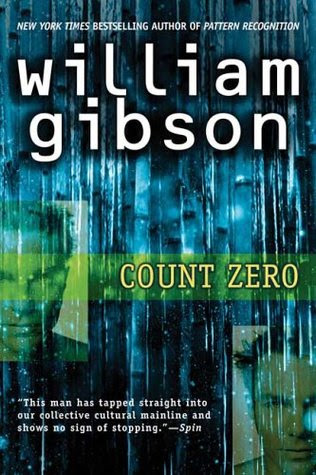
Count Zero, William Gibson, Arbor House, 1986, 246 pp

Count Zero follows Neuromancer as the second book in Gibson's Sprawl Trilogy. Sprawl is his term for a future mega-city stretching from Boston to Atlanta, connected by a cyber network populated by jackers, criminals and various semi-religious beings that include AIs.

As wild as this must have sounded in the 1980s, one gets the sense these days that such guys might actually exist in the world.

I liked this one even a bit more than Neuromancer because the main characters had more humanity to them. Like you can be a keyboard cowboy and still have a heart? Plus this time I felt more at home in Gibson's crazy world.

Count Zero is a new character, a misfit high school boy who wants to play in the cyber network and ends up helping Turner, the main character in the earlier book, out of his next hot spot.

 A good technopunk adventure.


Airs Above the Ground, Mary Stewart, Fawcett Publications, 1965, 255 pp

This one came from the 1965 list of My Big Fat Reading Project. It was nominated for an Edgar Award and I have been following her novels through a couple of decades. 

Vanessa March has agreed to escort her best friend's 17 year old son to Austria. Actually she herself is on a mission to track down her husband who is supposedly in Stockholm on business but is worryingly out of touch. Vanessa has just seen his picture in a newsreel story about a circus fire in Austria.

Naturally she fears the worst: that he is with another woman. She and the boy, Timothy, visit the scene of the fire at the circus and stumble into a web of stolen goods, international drug smuggling and the disappearance of a famed Lipizzaner stallion after his groom died in the fire.

In true Stewart fashion, we learn plenty about circus life, dressage and life in an Austrian village. Vanessa and Timothy, on the trail of the stallion, stay in an old castle, now a hotel. The atmosphere there is distinctly Gothic. The details of the horse with his ability to do the dressage movement called "airs above the ground" is woven into the story, which sometimes interrupts the suspense but it always gets back to the mystery soon enough.

I was captivated all the way by this page turner of a mystery.

Have you read any of these books or others by this author? What mysteries or thrillers have you enjoyed lately?

Monday, November 09, 2020

THE PRINCES OF IRELAND


The Princes of Ireland, Edward Rutherfurd, Doubleday, 2004, 765 pp


I attempted to read this historical fiction set in early Ireland years ago when we traveled to the country. Though it is like Rutherfurd's other books as well as like Michener's, in that it follows certain families through the generations, I just could not grasp it. It seemed like too much work.

Early in September I decided to read the biography of WB Yeats I bought last year when I was reading his collected poems. Starting the biography I realized Yeats's life was very much tied up with political events during the years he was writing and though I have read quite a bit of Irish fiction I still have confusions about those conflicts.

I still had The Princes of Ireland on my shelves so I gave it another try. My experience of reading The Thrall's Tale gave me a more determined approach and I found Rutherfurd's book less daunting. He provides maps and family trees. Perhaps I have become a better reader too!

I learned much of what I needed to know. Even though I had pored over maps before our trip there, I got a  better idea of the geography. I learned about the early years (400 AD) when the island's people were Celtic, arranged in families, clans and tribes and divided into five kingdoms, each with it own king. 

Later came the Vikings, then the English and the French. St Patrick brought Christianity which gradually overtook the ancient religions, gods and spirits. The monks of Ireland are included in the book and some of those characters were the ones who kept the written scriptures from falling away during the Medieval centuries. 

By 1533, the English were well ensconced as traders and financial leaders especially in Dublin. The Catholic Church and the Pope were in charge of religion but the Irish people, even those who intermarried with both the Vikings and the English, maintained certain differences and an individualism recalled in their poetry, songs, tales and monuments. 

The book ends with a revolt against the English, rather a cliff hanger. There is a volume two in The Dublin Saga, entitled The Rebels of Ireland, which will take me to 1914. Since Yeats was born in 1865, I should be in better shape to understand his life and times.

Saturday, November 07, 2020

NOVEMBER READING GROUP UPDATE


Another month on Zoom but what a line-up my groups have, all so in tune with the times. Also instead of wringing our hands, we can celebrate as we discuss the outcome of the election and truly feel that all our reading and study can make us better citizens and agents for positive change. Does anyone else feel you have been holding your breath for 5 years and can now take a deep breath while preparing to face whatever comes next?

One Book At A Time:


Carol's Group:

Bookie Babes:

Tiny Book Club:

Yes, two groups chose books about Ruth Bader Ginsburg, who I trust is jumping for joy from the afterlife. Plus we have one book about science vs faith and one about the plague.

Have you read or discussed any of these books? What are your groups discussing in November?

Wednesday, November 04, 2020

HOW TO WRITE AN AUTOBIOGRAPHICAL NOVEL


How To Write An Autobiographical Novel, Alexander Chee, Houghton Mifflin Harcourt, 2018, 380 pp


 I have wanted to read this book ever since it was published. Now, thanks to The Tiny Book Club, I have. Because I had read with great pleasure Chee's 2016 novel, The Queen of the Night, I knew he was a wonderful writer. Now I know how he became one.

In a series of autobiographical essays, collected and revised, he tells a great deal of his life story, including his family background, his education, his writing teachers and his first forays into publishing. These essays just sing with story and humor and emotion. 

For me, both the boon and the conundrum coming from my reading the book, were how it caused me to examine my own approach to writing. I won't go into all the soul searching and changes Mr Chee put me through, because it was personal in a way I could only try to convey to my reading group members, one a published poet and the other a highly educated reader.

If you are a writer at any stage of becoming or growth, I highly recommend the book, not so much for learning the craft or the business of writing but for how to BE a writer. It is one of the best I have read and I have read plenty.

Monday, November 02, 2020

BOOKS READ IN OCTOBER


I was not a very prolific blogger in October but I was a versatile reader. Everything from family sagas to cyberpunk to short stories to gothic to historical to biography. Short quick reads to lengthy tomes. I read nine books and have not reviewed one of them yet here, though I have several reviews written and they may come at you fast enough to divert you while the votes get counted.

Stats: 9 books read. 8 fiction. 6 written by women. 1 thriller. 1 mystery. 1 short story collection. 1 historical novel. 1 biography.

Countries visited: United States, Austria, Vietnam, Japan.

Authors New To Me: Shirley Grau, Asha Lemmie, JD Zahniser, Jean Kyoung Frazier

Favorites: The Sympathizer, Bellefleur.


Have you read any of these? What were your favorite reads in October?


Friday, October 30, 2020

WHAT NOW

 In these final days of the 2020 Election campaign, as I talk to friends and acquaintances, it is clear that worry is a big part of many people's emotional equation, including mine. So I am reposting here what I had to say after the last election, because no matter what the outcome is this time, I stand by my conclusions of four years ago. 

Here is a link: https://keepthewisdom.blogspot.com/2016/11/what-now.html

Here is a copy of the post: 

What Now?

I feel bad. I feel abused. I feel like taking to my bed with a bottle of vodka. I feel outraged at my country. I feel like I am suffering from a great loss and cannot think straight. I feel apathetic. I feel afraid. I feel guilty. I feel small. I feel confused. 

All through this Presidential election campaign, I felt a growing awareness that the country I am living in is not the country I thought I was living in. Now I know for sure that I have not really been looking at my country as it is. I was lulled into a feeling of hope and security by evidence that change was truly happening: change for women, minorities, and the under-represented people in our society. I thought we were ready for a woman to be our President, a woman who had the experience, the courage, and the will to continue the fight for true freedom of all people in our land but who could navigate the treacherous waters of the world as it is, who could continue to redeem our country in the eyes of the world. 

I did not realize the extent of the anguish many of my fellow Americans are going through everyday as they try to make a living. I did not realize how very angry are the white, straight, conservative Christian men and women of this country. How ripe this segment of our society, who are still a slim majority, were for the con game of a demagogue who has played on their fears and insecurities to advance his own hunger for power and recognition.

I could not bring myself to post a blog about a book I read three weeks ago before this rude awakening was forced on me. Even though this morning, when I checked my reading log, I see that the next book I was to post a review about is actually completely apropos: The Big Green Tent by Ludmila Ulitskaya, a novel about Soviet Russia in its latter days. 

I watched Hilary Clinton’s address to her campaign team yesterday morning and once again admired her courage, her clear thinking, and all the other qualities she has for leadership. I went to my reading group last night to discuss Last Days of Night by Graham Moore, a wonderful piece of historical fiction about the early years of electric power in America; the intersection of science, finance, and the law. We discussed, we drank wine, we got to giggling about pussy grabbing. The gloom began to lift.

This morning I read a great article on Lit Hub: Literary Voices React to President Donald Trump. Again I went through the whole spectrum of emotions. I started making decisions about my future reading. At one point I decided to read only books by women of all races, creeds, and nationalities. At another point I decided to drop the blog and just work on my Big Fat Reading Project and my memoir. I jotted down a quote from Dan Peipenbring of the Paris Review: “And read as often and as violently as you can.”

As always, I was restored by writers. 

Lately, in my life, I have been pondering the concept of rebalancing. It is an ecological, Buddhist, Tao Te Ching, long-view concept. Human beings get out of balance due to all kinds of factors that are part of daily life but some cosmic force works always to bring the dichotomies of life back into balance. All of those emotions I cited in the first paragraph of this essay are brought about by the terror of things getting so out of balance that life or the universe will end. 

My conclusion today is that I had not totally been facing how out of balance the world and the human race truly is at this time. It is not that I did not know that. It is that I thought things were improving. And I think they are but not as much as I had thought. A huge factor in the cosmic force towards balance is sentient beings. When the storm is over, when the fire is out, when the smoke clears, it is up to sentient beings to come out of disaster mode and start thinking, planning, setting things to rights. 

The best sentient beings I know are people who read and write, clearly and as truthfully as they can. That is us! Bloggers, readers, authors, publishers. We dare not give up, give in, or stay silent. We need to read it all, even the words of white male chauvinist bigots. Everyone in a free society gets to have a say, we need to know the enemy and understand him, and we need to be in conversation with him. 

So, I will read, I will write, I will attempt to be in concert with the forces of balance, I will not pander, I will not be silent. I will be back tomorrow with my next review. 

Thank you for visiting and reading my blog. Take heart, carry on, be the change you want to see in this world, keep the faith, and all that good stuff!


Wednesday, October 28, 2020

NOT WITHOUT LAUGHTER


Not Without Laughter, Langston Hughes, Random House, 1930, 299 pp


I read this for my Bookie Babes reading group. It was hard to believe that it was published in 1930! I will tell you why.

The story concerns Black lives centered around a family living in Lawrence, Kansas. Sandy is a growing boy living with his grandmother, his mother and two aunts. Grandma is a widowed washer woman, supporting three daughters and Sandy. Each daughter eventually goes her own way, but Sandy stays with his grandma until she dies, though he is influenced by the widely differing life styles of his mom and aunts.

The novel finally made me understand why so many Black women were deep into religion and church. They needed to believe in an afterlife that is not full of hardship, loss and suffering. It was also made clear why others look for good times and laughter or believe in education as a way to be able to compete with white people.

I always thought Langston Hughes was a poet, but he was also a wonderful novelist. His writing is lyrical, his characters are deep and rich with life, and the story kept me on the edge of my seat wondering what would become of everyone.

What struck all of us in the reading group was how much life is still the same for Blacks. Maybe a bit less harsh but still not really free, not really playing on a level field with the rest of society. It is now 90 years since the book was published. 156 years since emancipation. Etc, etc.

Yet, Langston Hughes brought major good things to his race. He came to recognition as a key player in the Harlem Renaissance in the 1920s with his support of other Black writers, his poetry, plays, novels and a special kind of hope and lightness of heart. 

Saturday, October 24, 2020

POSTCOLONIAL LOVE POEM


 Postcolonial Love Poem, Natalie Diaz, Graywolf Press, 2020, 100 pp


I received this poetry collection as the June selection of The Nervous Breakdown Book Club. I had not known about Natalie Diaz previously. I followed my usual practice of reading a poem each night before bed.

The poet is Native American, born and raised in the Fort Mojave Indian Village on the edge of Needles, CA. In other words, on the reservation, which sits on the banks of the Colorado River. She is a member of the Gila River Indian Tribe. She teaches and holds the Chair in Modern Contemporary Poetry at Arizona State University. Her book has been shortlisted for the National Book Award for Poetry. This is a woman who gets things done!

The poems cover Native American issues, legends, relationships with land and air and water and animals. They also reveal the depth of Natalie's passion for her partner--sensual, sexy, hot! Survival, oppression, freedom, philosophy, love and humor are her subject matter. ("Top Ten Reasons Why Indians Are Good At Basketball" is an example of some of her humor.)

I humbly admit, in many of the poems I could only guess at the meanings of some of her words and lines. However I was never in doubt about her intensity, her passion. After I came to the end of the poems, I discovered she had written notes for some of the poems. So now I need to go back and read those again.

I also listened to her interview on the Otherppl podcast where I learned much about her life so far. You can listen to Natalie reading some of her poems here.

Sunday, October 18, 2020

TOP TEN FICTION BESTSELLERS OF 1965

 Over the summer I completed reading the 1965 bestseller list for fiction. If you have followed my blog for a while you are familiar with what I call My Big Fat Reading Project. If you are new, go to the link to learn about why I read these best selling novels of long ago.

I have only reviewed three of the ten books here and I will provide the links to those reviews. Otherwise I will give you a brief synopsis of the other seven. The purpose of this post is to give my thoughts on how these books shed light on the events of 1965. It is my theory that in the 20th century the bestseller lists, which are based on sales, give evidence of the interests and concerns of fiction readers in any given year.


#1: The Source: Michener used the framework of an archeological dig at an ancient site in Israel to cover the vast history of Judaism, Christianity and Islam. Religious themes always sold well in the early years of the 20th century, but had not been as popular in the 1960s. I would think this one was of interest because of the growing tensions in Israel in the decade. 

Michener shows the connections between the religions and provides a history of their major conflicts. He made me think about religion, why humans need the idea of God, how religion had brought both order and chaos to our lives. An excellent read.


#2: Up The Down Stair Case: Bel Kaufman's book about her first year teaching in a public NYC high school is both hilarious and cautionary. The rules, the disorganization, the lack of supplies but most of all the challenges of making learning important to inner city teens, give what I was quite sure was an accurate picture of the scene. I wonder if LBJ's War on Poverty spiked an interest in this one.


#3: Herzog: This novel was also the #3 bestseller in 1964 and then won the National Book Award in 1965. It is his 6th novel but the first to make the top ten bestseller list. A middle aged intellectual is betrayed by his best friend who steals his wife. Bellow had cashed in on the midlife crisis plot before and since men still read fiction in the 60s, he did it again. 


#4: The Looking Glass War: The Cold War produced the spy fiction genre and Le Carre first hit the bestseller list in 1964 with The Spy Who Came in From the Cold. By his own admission, after that success , le Carre wanted to tell the real truth about the state of British intelligence in the early 1960s. The novel is grim. He shows a nation no longer the world power it was. Intelligence has become a political endeavor inside the offices of the military and intelligence branches. He became the antidote to Ian Fleming and James Bond.


#5: The Green Berets: These guys were the sexiest of military intelligence operatives during the Vietnam War so it is no surprise that this revealing but patriotic inside look at how they did the job would be a bestseller. I was appalled.


#6: Those Who Love: Irving Stone's biographical novel of Abigail and John Adams and their roles in founding American democracy must have had high appeal to readers still reeling from the assassination of JFK. For me, reading it in 2020, it was an indictment of how we have failed to keep those ideals. To his credit, John Adams as portrayed here had his doubts about that very thing at the time.


#7: The Man With the Golden Gun: This was the final James Bond novel. It takes place in Jamaica, though begins with Bond being brainwashed by the Russians after his capture in the prior book, then being given electric shock therapy by MI6 to make him fit for another mission. Again, the Cold War makes for bestsellers.


#8: Hotel: Arthur Hailey made his career with this first top ten bestseller. It is set in a famous New Orleans hotel which has seen better days and is now facing a hostile takeover by a hotel chain. Racism plays a large part in the story and that made it ripe for the times in 1965.


#9: The Ambassador: This was Morris West's third top ten bestseller. The second book on this list set in Vietnam, it is a fictionalized account of the months leading up to the CIA backed coup and assassination of South Vietnam's President Ngo Dinh Diem. The CIA giveth and the CIA taketh away when their implanted rulers stop playing by US rules. The novel does a fair job at showing the complexities of Vietnamese politics at the time and the toll this took on an American ambassador to the country. It captures that moment when LBJ began to plan his major escalation of the war.


#10: Don't Stop the Carnival is one of Herman Wouk's whimsical novels. A Broadway promoter decides to get away from the constant pressure of his job and the harsh New York winter by buying a hotel on a fictional Caribbean island that feels a lot like Jamaica. What was it about Jamaica in 1965?. It is a rip roaring read with some cringe inducing views of the natives who of course are Black and the many gay people who have taken refuge there from the homophobia of America. 

So there you have it. Have you read any of these books? I felt they gave me a pretty good picture of some of the major issues and concerns in America in 1965. I am now reading the novels that won awards in that year and will create a similar post when I finish those.

Sunday, October 11, 2020

BRIDGE OF CLAY


Bridge of Clay, Markus Zusak, Alfred A Knopf, 2018, 534 pp


This is the second novel by Markus Zusak, following The Book Thief. I read it for the One Book At A Time reading group.

From the title I thought it would be about a bridge made of clay. Instead it is about a character named Clay who builds both a literal bridge made of stones and a figurative bridge in order to heal his broken family.

Clay is the fourth of five brothers living in Australia. Their father married a refugee from Eastern Europe and it was one of those wonderful marriages full of love. The eldest brother, Matthew, narrates the story of his family. Weaving back and forth in time, he reveals the tragedy that shattered the love and closeness between two parents and five boys. To tell what form that tragedy took and the effects it had would be nothing but a spoiler.

The writing is as imaginative as that in The Book Thief. Because of how convoluted the plot is, some of my reading group members were so baffled that one did not finish, one was quite bitter about the time spent reading it. This provided quite a raucous discussion!

I read all 534 pages in three days. I grew to love trying to figure out the many mysteries presented and to care for all the characters, even the unlikable ones. Zusak covers a large amount of time, a multitude of incidents, and many characters. The antics and adventures of the five brothers were never dull. 

Clay is a sort of Christ-like figure though it is not a religious story at all. Instead it proclaims the power of love to overcome tragedy and misunderstanding.

Friday, October 09, 2020

OCTOBER READING GROUP UPDATE


Yes, my reading groups are still meeting on Zoom. We may be doing so for a while yet. It is still better than no reading group meetings at all. As you will see, in this month of impending doom and desperate hope for better days ahead, the books this month are all in some way political.

One Book At A Time:


Carol's Group:


Bookie Babes:


Have you read or discussed any of these books? What are your reading groups discussing this month? If you were in a reading group what books would you want to discuss? 

Sunday, October 04, 2020

WHITE MASKS


White Masks, Elias Khoury, Archipelago Books, 2010, 303 pp; (originally published in Lebanon, 1981, translated from the Arabic by Maia Tabet)


This was the translated book I read in September. Elias Khoury is Lebanese. I have read two other novels of his and loved them both: Gate of the Sun and As Though She Were Sleeping. Like those two books, White Masks takes place in Beirut. Since that country had been in the news, I thought it might be appropriate.

Though the novel was published in the United States in 2010, it was originally published in Lebanon in 1981, making it one of his early novels. It covers a period of months during the Lebanese Civil War which lasted for 15 years, 1975-1990. The war was religious, political, and devastating to the country.

The corpse of Khalil Ahmad Jaber, a civil servant, was found in a mound of garbage. He had been missing for weeks before he was found. A journalist, who narrates the story, sought to piece together what had happened to Jaber. He interviews many people, including the man's widow. Thus the reader gets a sense of life in Beirut during the early part of the war.

I won't tell you this was easy to follow. Each person interviewed has their own particular story to tell about Jaber, about his or her own life and about the violence around them. I got a sense of what it was like for everyday people, for the police and the soldiers. Hard times for all and quite a bit of brutality. Khoury shows the breakdown of society typical of any area where war is being waged.

It was a brilliant way to portray all of that and it was also a mystery. I was interested in the effects of civil war on the psyches and inner lives of men, women and children. The front cover blurb speaks of the resilience of people. I did not get that. I got that such an amount of chaos and uncertainty breaks people. It certainly broke Khalil Ahmad Jaber.

Some American pundits claim we may be heading for civil war in America. I sincerely hope we do not come to that.

Friday, October 02, 2020

BOOKS READ IN SEPTEMBER


My reading in September was all over the place. I had a plan but instead I picked up whatever looked good on my shelves. Of course I read the picks for my reading groups and finished both a poetry collection and a book of essays I had been reading for a while. All in all I had a feeling of freedom.

Stats: 13 books read. 10 fiction. 5 by women. 1 historical fiction. 2 thrillers. 2 children's books. 2 nonfiction. 1 translated. 1 poetry.

Countries visited: United States, Lebanon, Italy, Australia, Ireland, Spain.

Authors new to me: Beatrice Schenk De Regniers, Maia Wojciechowska, Natalie Diaz, Langston Hughes.

Favorites: Deacon King Kong, The Just City, Not Without Laughter, High Country
Least favorite: The Kandy-Kolored Tangerine-Flake Streamline Baby


The new Blogger has forced me to retrieve book cover images in a new way. I cannot seem to control the size of each image which bothers me. Hopefully it won't bother you. I am behind on my reviews, as usual, so if you want to find out more about a given title you will have to go to Goodreads or somewhere else on the web. If you have any tips for me on this matter, please let me know.

Have you read any of these titles? What were your favorite reads in September?